

South Dakota Cannabis Banking
Discover Banking for Your Hemp Business with Herring Bank’s Specialized Solutions for Hemp and CBD Enterprises in South Dakota, The Mount Rushmore State.
Ready to get started?

Discover Banking for Your Hemp Business in South Dakota
Herring Bank’s Specialized Banking Solutions for Hemp & CBD Enterprises in South Dakota, The Mount Rushmore State
Navigating the financial landscape for hemp and CBD ventures in South Dakota requires a banking partner that understands the industry’s unique regulatory and operational demands. Herring Bank offers tailored financial services designed to support hemp businesses in The Mount Rushmore State—from cultivation on the Great Plains to retail in bustling urban centers.
Why South Dakota Hemp Businesses Choose Herring Bank:
- State & Federal Compliance Expertise: Stay aligned with South Dakota hemp laws and federal regulations (2018 Farm Bill), including licensing and reporting requirements for growers, processors, and retailers.
- Customized Financial Tools: Simplify operations with business checking/savings accounts, mobile banking, ACH/wire transfers, and secure tax payment solutions tailored to your needs.
- Secure Cash Management: Partner with trusted armored courier services for safe cash transport, essential for high-volume CBD retailers in Sioux Falls, Rapid City, or rural communities.
- Dedicated Support: Our hemp-industry banking experts assist with payroll, vendor payments, and scalable financial strategies to fuel your growth.
Grow Your South Dakota Hemp Business with Confidence
Whether you’re farming hemp under the wide-open skies of the Great Plains or selling CBD products in downtown Sioux Falls, Herring Bank provides the financial infrastructure and expertise to help you thrive. With FDIC-insured accounts, digital banking tools, and compliance guidance, we empower you to focus on innovation—not paperwork.
Bank on Tradition. Partner with Progress.
Serving hemp and CBD businesses statewide, including Sioux Falls, Rapid City, Aberdeen, Pierre, and beyond.
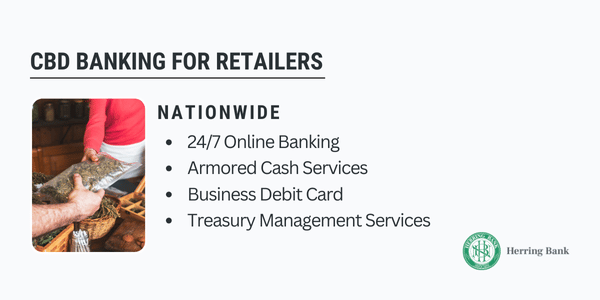
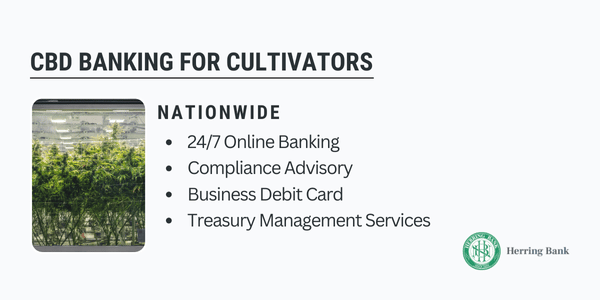
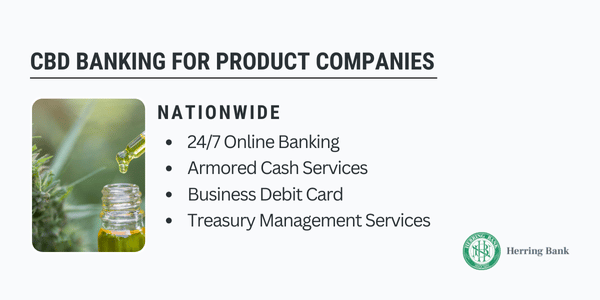
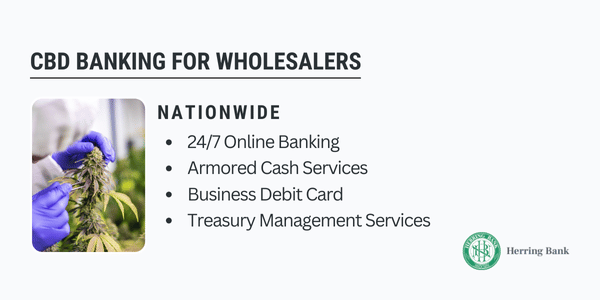
Tailored Hemp & CBD Banking Services for South Dakota
Herring Bank’s South Dakota Hemp & CBD Banking Program
Herring Bank proudly introduces a specialized banking initiative designed to meet the unique financial needs of South Dakota’s hemp and CBD industries. Our program delivers compliant, secure, and scalable banking solutions for hemp growers, processors, and retailers, empowering businesses to thrive in The Mount Rushmore State.
Program Highlights
- 24/7 Digital Banking: Manage accounts remotely with online and mobile tools, enabling seamless transactions, electronic tax payments, and real-time financial oversight—all while maintaining compliance with South Dakota hemp laws and the 2018 Farm Bill.
- Secure Cash Flow Solutions: Minimize cash-handling risks with FDIC-insured deposit accounts, armored cash transport services, and tailored cash management tools—ideal for high-volume CBD retailers in Sioux Falls, Rapid City, or rural farming communities.
- Streamlined Workforce Management: Simplify payroll with direct deposit, ACH payments, and wire transfers, ensuring timely compensation for employees and vendors across South Dakota’s agricultural and retail sectors.
- Compliance-First Approach: Navigate South Dakota’s regulatory landscape confidently with guidance on licensing, reporting, and state-specific requirements for hemp and CBD operations.
Why South Dakota Hemp Businesses Trust Herring Bank
From cultivating hemp under the vast skies of the Great Plains to selling CBD products in downtown Rapid City, Herring Bank provides the financial infrastructure to support your growth. Our expertise in agriculture-focused banking ensures your business stays compliant, secure, and ready to scale.
2026 Cannabis Banking in South Dakota: Medical Cannabis, Hemp and CBD Laws
South Dakota has two legal cannabis markets in 2026: a voter-approved medical cannabis program run by the Department of Health, and a hemp and CBD sector regulated by the Department of Agriculture and Natural Resources. Recreational marijuana remains illegal. For dispensaries, cultivators, manufacturers, hemp growers and CBD retailers in Sioux Falls, Rapid City and across the Mount Rushmore State, South Dakota cannabis banking means compliant accounts, safe cash handling and a bank that can tell these markets apart.
South Dakota Medical Cannabis: Program Status in 2026
South Dakota voters approved medical cannabis in 2020, and the South Dakota Department of Health (DOH) licenses and inspects every medical cannabis establishment. DOH issues certificates to dispensaries, cultivators, manufacturers and testing facilities and requires an official seed-to-sale tracking system for all plant stages. The program’s latest official numbers:
- Patients: 20,040 registered patients, 631 caregivers and 212 certifying providers as of September 2026.
- Establishments: 62 dispensaries, 30 cultivation facilities, 14 manufacturers and 1 testing lab on DOH’s establishments list (updated August 27, 2026).
- Largest local markets: Rapid City has 10 licensed dispensaries and Sioux Falls has 6, with others spread across Aberdeen, Brookings, Yankton, North Sioux City and smaller communities.
Recreational Marijuana and 2026 Legislative Developments
Adult-use marijuana has been on the South Dakota ballot three times. Voters approved Constitutional Amendment A in 2020, but courts struck it down; voters rejected a legalization measure in 2022 and again rejected Initiated Measure 29 in November 2024. The medical program has held steady in the Legislature as well. In February 2026 a Senate committee rejected SB 181 and SB 194, bills that would have repealed or restricted the medical program.
Federal policy shifted in 2026. Effective April 28, 2026, the Justice Department and DEA moved marijuana subject to a qualifying state medical license to Schedule III, with a DEA registration pathway for state medical licensees and the expectation that licensed medical activity falls outside Section 280E going forward. In October 2026, Attorney General Marty Jackley issued an opinion, requested by the vice chair of the Medical Marijuana Oversight Committee, concluding that rescheduling does not change how South Dakota’s program operates. Any further changes are up to the Legislature or voters.
South Dakota Hemp and CBD Rules
South Dakota’s hemp program is run by the Department of Agriculture and Natural Resources (DANR), which took over the former Department of Agriculture’s duties. Key rules:
- Licensing: hemp growers and processors need a DANR license, valid for 15 months from issue, with background checks, inspections and THC compliance testing.
- THC limits today: hemp must test at or below 0.3% delta-9 THC, and CBD retailers must meet labeling, testing and packaging standards so products do not cross into marijuana.
- Federal redefinition: the federal hemp law enacted in November 2025 (P.L. 119-37) moves to a 0.3% total-THC standard that counts THCA, excludes synthesized cannabinoids and excludes finished products with more than 0.4 mg of total THC per container. Most provisions take effect December 11, 2026, which will remove many intoxicating hemp-derived THC products from the legal market.
Herring Bank offers dedicated hemp banking and CBD banking for South Dakota growers, processors and retailers.
What This Means for Banking a Cannabis or Hemp Business in South Dakota
Federal banking law has not changed for medical cannabis businesses: the SAFE Banking Act of 2026 (S. 4942) remains in committee, so banks still follow FinCEN’s guidance for marijuana-related businesses, including enhanced due diligence and Suspicious Activity Report filing. Herring Bank works with South Dakota dispensaries, cultivators, manufacturers, hemp growers and CBD retailers to open compliant operating accounts, document DOH or DANR licensing for BSA/AML review, manage cash with pickup and delivery through our preferred armored courier, and run payroll, ACH, wires and electronic tax payments. Ready to talk about South Dakota cannabis banking? Call 877-873-0079 or request a call back.
Challenges for Hemp and CBD Businesses
Despite progress, businesses face hurdles:
- Banking Access: Many financial institutions remain hesitant due to lingering stigma, forcing businesses to rely on cash transactions.
- Compliance Costs: Licensing fees, testing, and audits strain small-scale operators.
- Consumer Education: Confusion persists around the differences between hemp-derived CBD, medical cannabis, and illicit products.


