Your Boston Cannabis Bank
Boston Cannabis Banking
Discover the best cannabis and CBD banking in Boston with Herring Bank. We’re one of America’s fastest-growing cannabis banks.
Ready to get started?

Comprehensive Cannabis Banking
In the vibrant city of Boston, Massachusetts, the cannabis industry is experiencing substantial growth, notably after the statewide legalization of recreational cannabis. To address the unique financial challenges encountered by businesses in this sector, Herring Bank has launched its Cannabis Banking program. This initiative is specifically tailored to meet the distinctive needs of medical marijuana, CBD, and cannabis banking, thereby bridging the gap left by traditional banking systems and ensuring the smooth functioning of cannabis-related businesses within a lawful framework.
Herring Bank’s Cannabis Banking program in Boston encompasses essential banking services vital for the industry, including checking and savings accounts, round-the-clock access to online banking, and supports both consumer and electronic tax payments. These offerings are pivotal for maintaining regulatory compliance and streamlining the financial operations of businesses active in the legal cannabis market.
Recognizing the industry’s inclination towards cash transactions and the critical need for secure cash management, Herring Bank provides customized solutions to address these issues. These solutions include secure cash pick-up and delivery services, along with investment opportunities designed to fortify the financial base of cannabis businesses, thereby preparing them for success in the rapidly developing Boston market.
Moreover, Herring Bank is committed to presenting employee-centric solutions, such as efficient payroll services, direct deposit, ACH payments, and wire services, to facilitate smooth fund transfers and payment procedures. The bank also crafts tailored account options to support business expansion within the cannabis industry.
Herring Bank’s devoted approach to servicing the legal cannabis market in Boston, Massachusetts, underscores its dedication to the operational and financial health of businesses in this sector. With Herring Bank’s expertise and specialized financial services, cannabis enterprises in Boston are positioned to successfully navigate the regulatory landscape, capitalize on growth opportunities, and positively influence the local economy and community well-being. This collaboration between Herring Bank and the cannabis industry highlights a shared commitment to developing a secure, responsible, and economically prosperous cannabis market in Massachusetts.
Boston, MA Cannabis Bank
In Boston, Massachusetts, amidst the flourishing cannabis market, Herring Bank stands as a tangible entity that carves a niche in cannabis banking, offering specialized financial services tailored for the cannabis, CBD, and medical marijuana sectors. Distinguished by its comprehensive approach to cannabis business and banking solutions, Herring Bank supports companies through a detailed application process tailored for new clients, setting a precedent for financial institutions in this space.
Leveraging its rich experience from Colorado’s complex cannabis industry, Herring Bank is well-equipped to guide and support businesses navigating the intricate world of cannabis banking in Boston. As a trusted financial partner, the bank enables businesses to thrive against the backdrop of a dynamic regulatory environment, offering a beacon of stability and compliance.
With a suite of educational resources and advisory services, Herring Bank aims to ensure that cannabis businesses remain compliant with the shifting federal and state regulations. This commitment not only positions clients within legal parameters but also primes them for sustained growth and success in the competitive cannabis market. Herring Bank’s dedication to banking excellence and innovation marks it as an invaluable ally for any cannabis business aiming to make a mark in today’s economy.
Boston Cannabis Banking
2026 Cannabis Banking in Boston: Laws, Licensing and Market Status
Boston is the most expensive place in Massachusetts to run a dispensary. That is why the city’s licensing board commissions its own market studies before it adds new stores. With a state reform law passed in April 2026 and the Question 8 repeal vote on November 3, Boston cannabis businesses face both local and statewide changes this year.
Boston’s Local Cannabis Rules: The Boston Cannabis Board and the Half-Mile Buffer
Every Boston cannabis business needs two approvals: a state license from the Cannabis Control Commission (CCC) and local approval from the Boston Cannabis Board (BCB). The city keeps a half-mile buffer between cannabis retailers, and applicants who want to locate closer must ask the Board for an exemption. The city’s Cannabis Equity Program provides grants and technical assistance to equity applicants, and, like other Massachusetts host communities, Boston may levy a local option tax of up to 3% on adult-use sales.
What Boston’s 2026 Saturation Study Found
The BCB’s 2026 retail saturation study, prepared by Whitney Economics, gives Boston operators an unusually detailed look at their market:
- Licenses: 61 retail licenses were in some stage of approval in Boston ZIP codes as of November 2025, and 35 were active.
- Break-even revenue: a Boston dispensary needed about $5.3 million in annual revenue in 2025 to stay viable, up 10.4% from $4.8 million in 2024, driven by high rents and wages. The statewide average was about $2.9 million per store.
- Saturation: counting residents only, licenses are at or above saturation in many ZIP codes. Counting the roughly 700,000 commuters who work in Boston daily, the city could support more stores, but mainly in about a third of its ZIP codes.
For Boston dispensaries, that means tight margins, and so banking costs need to be predictable and cash handling efficient.
Massachusetts Rules That Apply in Boston
- Taxes: 10.75% state excise, 6.25% sales tax and up to 3% local option tax on adult-use sales (medical is exempt), per the CCC.
- 2026 reform law: Chapter 65 of the Acts of 2026, signed April 19, shrinks the CCC to three governor-appointed members, lets one company hold up to six retail licenses instead of three, raises the purchase and possession limit to two ounces, and ends the requirement that medical operators grow their own product, as WBUR reported.
- Social consumption: state social consumption regulations took effect January 2, 2026. On-site consumption licenses are available only in municipalities that opt in, so a Boston lounge depends on city action.
- Market size: statewide adult-use sales were $1.65 billion in 2025, and all-time sales passed $10 billion in September 2026 across 782 operating businesses.
Question 8 and Boston Cannabis Businesses
On November 3, 2026, Massachusetts voters will decide Question 8, the first statewide measure to repeal an existing adult-use market. If it passes, licensed adult-use sales would end in 2028 while medical marijuana continues and adult-use stores could apply for medical licenses on an expedited basis. A September UNH poll found 71% of voters planned to vote no, NORML reported, and results will not be known until after Election Day. Either way, Boston dispensaries keep operating, banking and paying taxes at least into 2028.
Federal Changes for Boston Operators
Effective April 28, 2026, the U.S. Department of Justice and DEA moved FDA-approved marijuana products and marijuana subject to a qualifying state medical license from Schedule I to Schedule III. That benefits Boston’s medical marijuana treatment centers, which gain a DEA registration pathway and are expected to be free of Section 280E going forward. The city’s adult-use retailers remain under Schedule I and 280E while the DEA’s broader rescheduling proceeding continues.
Federal banking law has not changed. The SAFE Banking Act of 2026 (S. 4942), with a House companion, H.R. 9471, was introduced in June 2026 and remains in committee. Until Congress acts, cannabis businesses need a bank that follows FinCEN guidance for marijuana-related businesses, including enhanced due diligence, ongoing monitoring and Suspicious Activity Report (SAR) filing.
What This Means for Banking a Cannabis Business in Boston
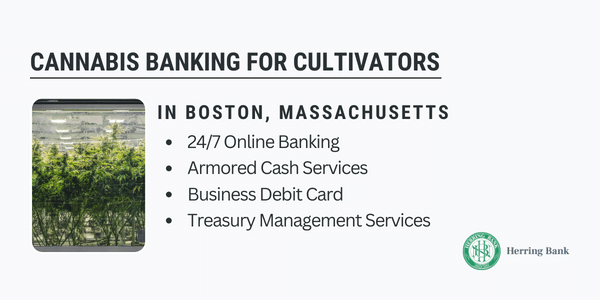
Herring Bank works with Boston dispensaries, delivery operators, cultivators, manufacturers and medical treatment centers. We open compliant operating accounts, document CCC and BCB licensing for BSA/AML review, provide cash pickup and delivery through our preferred armored courier, and run payroll, ACH, wires and electronic payment of the state excise, sales and Boston local option taxes. Ready to talk about Boston cannabis banking? Call 877-873-0079 or request a call back.
Frequently Asked Questions (Boston)
What taxes apply to adult-use cannabis in Boston?
Adult-use sales are subject to 10.75% state excise, 6.25% state sales tax, and up to 3% local option tax (medical sales are tax-exempt). See the CCC’s (unchanged) and Massachusetts’ sales-tax rule (unchanged).
What local approvals do I need to open in Boston?
Beyond state licensure, you must apply through the (unchanged) and follow the City’s steps to (unchanged). The City also publishes a helpful (unchanged).
What’s the status of delivery licensing in Massachusetts?
The CCC has extended delivery-license exclusivity (Courier, Operator, Endorsement) to at least April 2026 and in March 2026 voted to extend it again, through April 2029. For pathways and training, see the CCC’s (unchanged).
What changed for testing transparency in 2025?
The CCC issued an (unchanged) requiring testing labs to upload Certificates of Analysis (COAs) to Metrc (effective June 16, 2025). See (unchanged) and the CCC’s (unchanged) for implementation details.
Which seed-to-sale system does Massachusetts use?
Massachusetts uses (unchanged) statewide as the seed-to-sale system of record.
Are there city equity grants or assistance?
Yes. Boston runs a (unchanged) offering grants and technical assistance; additional support is noted in the City’s (unchanged).
Can Boston dispensaries use banks?
Yes. Financial institutions that bank CRBs follow (unchanged) with enhanced due diligence and SAR reporting.