Your NYC Cannabis Bank
New York City Cannabis Banking
Discover the best cannabis and CBD banking in New York City with Herring Bank. We’re one of America’s fastest-growing cannabis banks.
Ready to get started?

The Herring Bank Cannabis Banking Program in NYC
Herring Bank’s Cannabis Banking Program is purpose-built for the operational and compliance realities facing New York City’s cannabis-related businesses (CRBs). With cannabis still federally restricted and the SAFER Banking Act (reintroduced in June 2026 as the SAFE Banking Act of 2026) yet to clear Congress, NYC dispensaries, cultivators, processors, and ancillary operators need a banking partner who understands both the regulatory framework and the day-to-day mechanics of moving money in this industry. We provide that partnership — at a flat, predictable rate.
Core Banking Built for Cannabis Operators
Every account in our program is structured to satisfy the BSA/AML reporting expectations that come with cannabis banking, while still functioning like the modern business banking your team needs to operate efficiently:
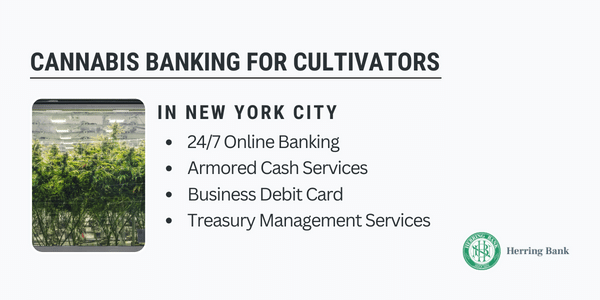
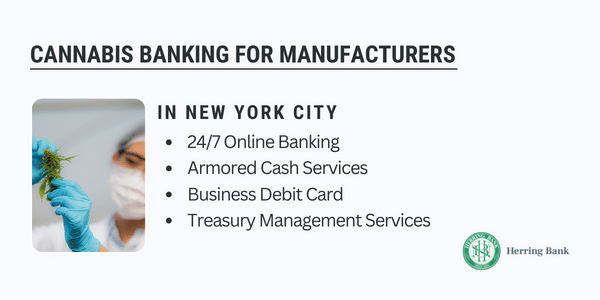
- Business checking and savings accounts with FDIC-insured deposits and transparent flat-rate pricing
- 24/7 online and mobile banking for real-time visibility into balances, transactions, and tax filings from anywhere
- Electronic tax payment capabilities to keep New York State excise and sales tax filings on schedule
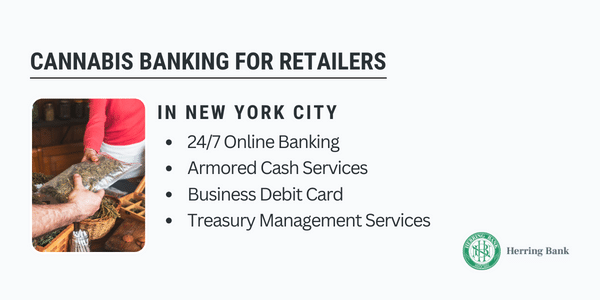
- Specialized cash management accounts designed for the high-volume cash flow typical of NYC dispensaries
Secure Cash Handling for High-Volume Operators
Cash-intensive operations are one of the cannabis industry’s biggest liability exposures — and one of the most cited public safety arguments made by 32 state attorneys general in their formal call for federal banking reform. Herring Bank reduces that exposure through:
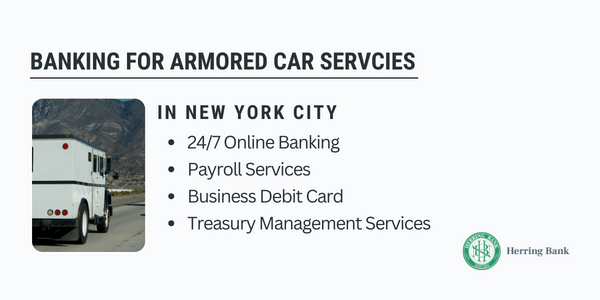
- Armored courier partnerships for secure cash pick-up, delivery, and transport across the five boroughs
- Cash management accounts structured to streamline reconciliation and reporting
- Access to over 30 Herring Bank ATMs and 55,000+ Allpoint ATMs nationwide for convenient access to funds
Payroll and Payment Infrastructure
Running payroll out of cash boxes is not a sustainable model for any business — let alone one with the staffing footprint of a multi-location NYC operation. Herring Bank’s payment infrastructure includes:
- Employee deposit accounts for staff who often struggle to find banks willing to onboard cannabis-industry workers
- Direct deposit payroll to eliminate the security risks and inefficiencies of cash payroll
- ACH payments and wire transfers for vendor payments, intercompany transfers, and tax obligations
- Compliance-ready transaction recordkeeping to support audits and regulatory inspections
Why NYC Cannabis Operators Choose Herring Bank
We’ve been serving cannabis-related businesses across multiple states for years — including programs in California, Colorado, and Washington — which means we bring real operational experience to the New York market, not a learning curve. Our compliance program is built, tested, and trusted by operators who can’t afford banking interruptions.
For NYC cannabis businesses, the choice between cash-only operations and a properly structured banking relationship isn’t really a choice at all. It’s the difference between a business that can scale, hire, and reinvest — and one that’s stuck managing risk it shouldn’t have to carry alone.
Built to Support Growth
New York’s cannabis market grew from $882 million in 2024 to over $1.69 billion in 2025 — and operators in NYC are scaling alongside that demand. Whether you’re opening a second location in Brooklyn, expanding cultivation upstate, or building out processing capacity, our program provides:
- Customized account structures that align with your specific business model and license type
- Commercial real estate loans up to 50% loan-to-value for the property your dispensary, cultivation or processing operation runs from
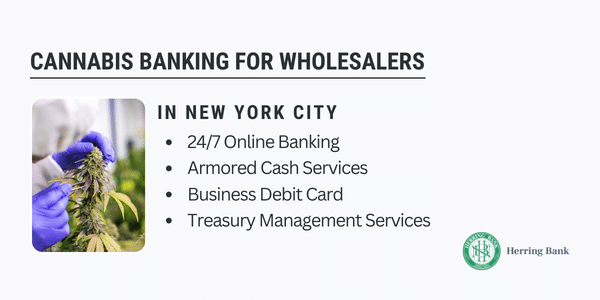
- Dedicated cannabis banking specialists who understand New York’s licensing categories — from CAURD operators to microbusinesses and registered organizations
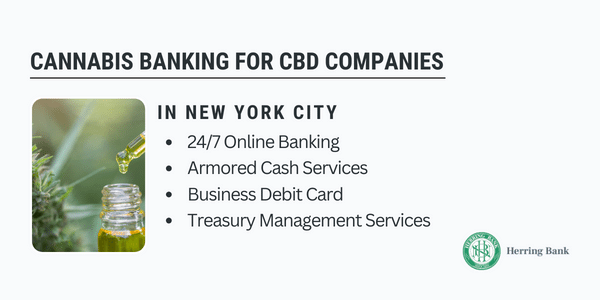
- Industry-adjacent programs, including hemp banking and CBD banking, for vertically integrated operators
2026 Cannabis Banking in NYC: Laws, Licensing and Market Status
New York City is the center of the state’s legal cannabis market. Of the more than 740 dispensaries on the Office of Cannabis Management’s dispensary verification list in mid-October 2026, about 320 have five-borough ZIP codes: roughly 100 in Manhattan, 95 in Brooklyn, 85 in Queens, 23 in the Bronx and 16 on Staten Island. NYC also has the state’s highest rents and some of its most crowded retail corridors, and its operators deal with the most cash. Here is what NYC cannabis businesses need to know about the rules and the market in 2026.
Who Regulates Cannabis in New York City
The city does not issue cannabis licenses. Every NYC dispensary, delivery business, processor and distributor is licensed by the state under the Marihuana Regulation and Taxation Act (MRTA), with the Office of Cannabis Management (OCM) handling licensing, compliance and enforcement and the Cannabis Control Board voting on approvals. Many Board meetings are held in New York City, and borough-level concerns come up regularly: at the September 3, 2026 meeting, members questioned dispensary density in a Bronx community board district and tabled one retail application pending more information on school proximity. Adult-use licenses renew every two years, and OCM asks licensees to file at least 60 days before expiration.
Enforcement Against Unlicensed Shops
Unlicensed smoke shops remain the biggest competitive problem for NYC’s licensed retailers. After the state budget gave the city new padlock authority, the NYC Sheriff’s Office launched Operation Padlock to Protect in May 2024 with the NYPD and the Department of Consumer and Worker Protection. At the time, city officials estimated roughly 2,800 illegal weed shops were operating across the five boroughs. For licensed dispensaries, enforcement matters to the bottom line: every illicit storefront that closes is demand that can shift to regulated, banked businesses.
Licenses and Market Data That Shape NYC Operators
- Statewide licenses: 2,322 adult-use licenses issued by August 2026, including 537 retail dispensaries, 360 CAURD licenses, 328 microbusinesses, 574 processors, 275 cultivators and 248 distributors, per the Cannabis Control Board’s August 2026 update. Of those licenses, 56% went to Social and Economic Equity applicants.
- Sales: $1.69 billion in statewide adult-use sales in 2025, according to OCM. In September 2026, OCM lowered its 2026 forecast to $2 billion, citing better Metrc data and retail price declines of 10% to 15%, even as unit sales grew 39% since January.
- Growth in storefronts: open dispensaries statewide rose from 582 in February 2026 to 705 in August.
Taxes on NYC Cannabis Sales
Adult-use purchases carry a 13% retail excise tax: 9% for the state and 4% for localities. Since June 1, 2024, the old per-milligram THC potency tax has been replaced by a flat 9% tax on adult-use cannabis product sales at the distributor level, and since December 1, 2024 the Department of Taxation and Finance has administered it. Medical cannabis sold by registered organizations carries a 3.15% excise tax on gross receipts.
2026 Compliance Priorities for NYC Licensees
OCM is phasing in statewide Metrc seed-to-sale tracking, including item-level identification at retail, and the state began paying Metrc tag costs for licensees on September 1, 2026, using $10 million set aside in the state budget. First-cycle renewals are under way, and Community Impact Plans filed before the 2028 renewal cycle are being treated as informational. For high-volume Manhattan and Brooklyn stores, clean Metrc records and bank records that reconcile to them are now central to both renewal and BSA/AML compliance.
Federal Changes and NYC Cannabis Businesses
Effective April 28, 2026, the U.S. Department of Justice and DEA moved FDA-approved marijuana products and marijuana subject to a qualifying state medical license from Schedule I to Schedule III. That helps the registered organizations that serve New York’s medical patients, including their NYC dispensing sites, which gain a DEA registration pathway and are expected to be free of Section 280E going forward. It does not cover the city’s adult-use dispensaries, which remain under Schedule I and Section 280E while the DEA’s broader rescheduling proceeding continues.
Federal banking law has not changed. The SAFE Banking Act of 2026 (S. 4942), with a House companion, H.R. 9471, was introduced in June 2026 and remains in committee. Until Congress acts, cannabis businesses need a bank that follows FinCEN guidance for marijuana-related businesses, including enhanced due diligence, ongoing monitoring and Suspicious Activity Report (SAR) filing.
What This Means for Banking a Cannabis Business in New York City
NYC operators face high rents, falling prices, heavy foot traffic and illicit competition, which leaves little margin for banking problems. Herring Bank’s NYC cannabis banking program opens compliant operating accounts for licensed dispensaries, CAURD operators, delivery businesses, microbusinesses, processors and distributors, and documents your OCM license and Metrc activity for BSA/AML review. We handle cash with pickup and delivery through our preferred armored courier, and we run payroll, ACH, wires and electronic payment of New York’s adult-use cannabis taxes. Ready to talk about NYC cannabis banking? Call 877-873-0079 or request a call back.
Cannabis Banking in 2026: Why It Still Matters
While New York’s regulated market has matured, federal banking access remains the industry’s most persistent structural challenge. The SAFE Banking Act of 2026 was reintroduced in June 2026 (S. 4942 in the Senate, with companion H.R. 9471 in the House) with bipartisan cosponsors, but as of October 2026 it remains in committee and has not received a Senate floor vote. Until federal reform passes, cannabis-related businesses (CRBs) cannot rely on most national banks for basic depository services, payroll, or commercial lending — making partnerships with cannabis-friendly institutions essential.
This is where Herring Bank’s cannabis banking program plays a critical role. As a nationwide cannabis banking specialist serving CRBs in New York and beyond, Herring Bank provides the financial infrastructure that cash-only operations simply cannot match.
How Herring Bank Supports New York CRBs
Herring Bank’s program is built specifically for the operational realities of cannabis businesses, with services that include:
- Compliance-focused business checking and savings accounts designed for the unique BSA/AML requirements of CRBs
- 24/7 online and mobile banking for managing accounts, payments, and electronic tax filings from anywhere
- ACH direct deposit and wire transfers for payroll and vendor payments
- Cash management solutions through a network of armored courier partners for secure pick-up, delivery, and transport
- Access to over 30 Herring Bank ATMs and 55,000+ Allpoint ATMs nationwide
- Flat-rate pricing for predictable monthly costs
- Specialized programs for related industries, including hemp banking and CBD banking
For a deeper look at how federal legislation could expand these services in the future, see our breakdown of the SAFE/SAFER Banking Act and what it means for cannabis businesses.
Looking Ahead
New York’s cannabis market entered 2026 with real momentum — more stores, more licenses, more jobs, and meaningful progress on social equity. But the fundamentals of operating a cannabis business in NYC still demand a banking partner that understands both the compliance requirements and the day-to-day realities of running a CRB. With sales projected to continue climbing and the licensing pipeline expanding into 2027, the businesses that pair operational discipline with reliable banking infrastructure will be best positioned to capture that growth.
Herring Bank’s commitment to this industry reflects more than a banking relationship — it’s a partnership built around helping New York’s cannabis businesses operate safely, transparently, and profitably in one of the country’s most dynamic regulated markets.
Ready to get started? Learn more about cannabis banking with Herring Bank or call 1-719-470-2340 to speak with our cannabis banking team.