

Massachusetts Cannabis Banking
Ready to get started?

Trusted Massachusetts Cannabis Banking Solutions
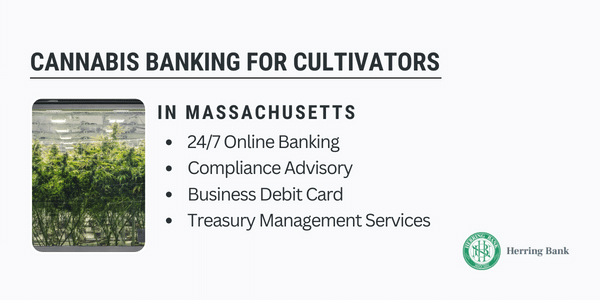
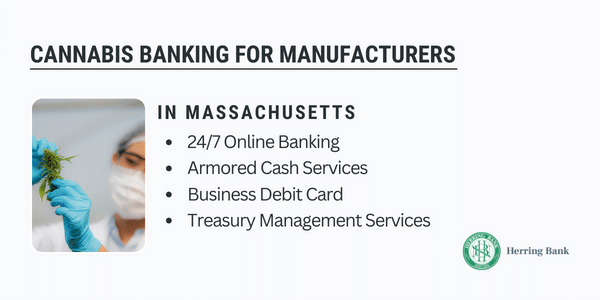
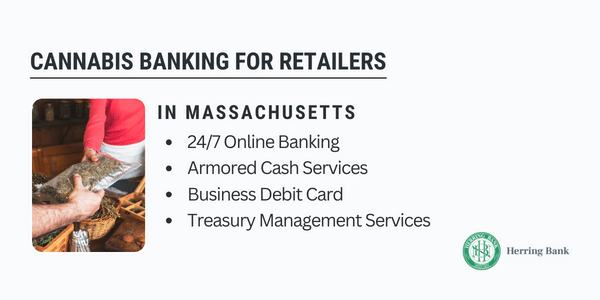
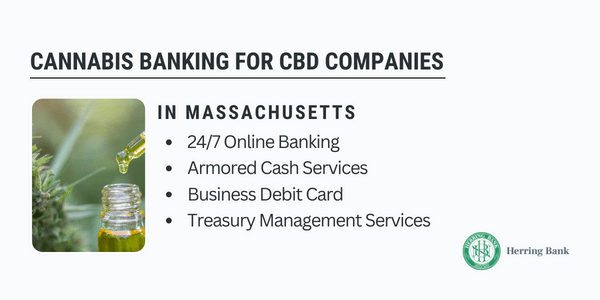
Marijuana Banking in Massachusetts
2026 Cannabis Banking in Massachusetts: Laws, Licensing and Market Status
Massachusetts has one of the most mature cannabis markets on the East Coast, with more than $10 billion in all-time adult-use sales. In 2026 it is also the first state where voters will decide whether to repeal legal adult-use sales. A major reform law in April and the Question 8 vote on November 3, 2026 make this an unusually important year for dispensaries, cultivators, product manufacturers and delivery operators to get their banking in order.
Massachusetts Cannabis Law and the Cannabis Control Commission
Medical cannabis has been legal since 2012, and voters approved adult-use cannabis through Question 4 in 2016, implemented as Chapter 334 of the Acts of 2016. Retail sales began November 20, 2018. The Cannabis Control Commission (CCC) licenses and regulates both programs. Chapter 180 of the Acts of 2022 gave it oversight of host community agreements and limits on community impact fees.
On April 19, 2026, Governor Maura Healey signed a major overhaul, enacted as Chapter 65 of the Acts of 2026. According to WBUR, the law:
- Shrinks the CCC from five commissioners to three, all appointed by the governor
- Raises the number of adult-use retail licenses one company may hold from three to six
- Doubles the per-transaction purchase and public possession limit from one ounce to two
- Ends the requirement that medical operators grow their own cannabis
- Creates an anonymous portal for reporting suspected illegal activity by licensees and a “delinquent” list that bars companies with unpaid debts from doing business until they pay
- Directs the commission to study unregulated hemp-derived THC and CBD products
Massachusetts Cannabis Taxes
Adult-use purchases carry a 10.75% state excise tax, the 6.25% state sales tax and a local option tax of up to 3%. Medical cannabis is exempt.
Where the Massachusetts Market Stands in 2026
- Sales: adult-use retailers sold $1.65 billion in 2025 and $1.09 billion through August 2026. All-time gross sales passed $10 billion on September 5, 2026.
- Licensees: 782 operating adult-use businesses, including roughly 400 dispensaries.
- Social consumption: regulations for social consumption establishments took effect January 2, 2026, creating Supplemental, Hospitality and Event Organizer licenses in municipalities that opt in.
- Delivery: in March 2026 the CCC voted to keep delivery licenses exclusive to social equity and economic empowerment participants for three more years, through April 2029.
Question 8: The November 3, 2026 Vote on Repealing Adult-Use Sales
Question 8 is the first statewide ballot measure in the country to repeal an existing adult-use marijuana market. Voting ends November 3, 2026, and results will not be official until after Election Day.
- What a YES vote does: it repeals the laws that legalize, regulate and tax retail adult-use marijuana sales. Licensed adult-use sales would end in 2028 (January 1, 2028, per the Secretary of the Commonwealth’s voter information). Medical marijuana would continue, and adult-use dispensaries could apply on an expedited basis for medical licenses.
- What stays legal: adults could still possess up to one ounce of marijuana and five grams of concentrate and grow at home, down from today’s two-ounce limit, according to WBUR.
- What a NO vote does: it keeps current law, including the 2026 reform law.
- What is at stake: state officials estimate that adult-use taxes raised about $280 million in state revenue and $50 million in local revenue in fiscal year 2025.
Recent polling points toward defeat. A September University of New Hampshire poll found 71% of voters planned to vote no, as reported by NORML, and Governor Healey has said she will vote no. The repeal campaign is funded mainly by Smart Approaches to Marijuana Action. Whatever the result, adult-use businesses would keep operating at least into 2028, so banking, payroll and tax obligations continue as usual through the transition.
Federal Changes That Affect Massachusetts Cannabis Businesses
Effective April 28, 2026, the U.S. Department of Justice and DEA moved FDA-approved marijuana products and marijuana subject to a qualifying state medical license from Schedule I to Schedule III. In Massachusetts, that applies to medical marijuana treatment centers operating under state medical licenses, which gain a DEA registration pathway and are expected to fall outside Section 280E going forward. Adult-use marijuana establishments remain in Schedule I and subject to 280E while the DEA’s broader rescheduling proceeding continues, so operators that hold both medical and adult-use licenses need to keep the two revenue streams separate.
Federal banking law has not changed. The SAFE Banking Act of 2026 (S. 4942), with a House companion, H.R. 9471, was introduced in June 2026 and remains in committee. Until Congress acts, cannabis businesses need a bank that follows FinCEN guidance for marijuana-related businesses, including enhanced due diligence, ongoing monitoring and Suspicious Activity Report (SAR) filing.
Hemp and CBD sellers face their own deadline: the federal hemp redefinition enacted in November 2025 counts total THC and excludes synthesized cannabinoids. The synthetic-cannabinoid exclusion begins November 12, 2026, and after a September 2026 extension most other provisions take effect December 11, 2026. Herring Bank offers dedicated hemp banking and CBD banking for operators working through the change.
What This Means for Banking a Cannabis Business in Massachusetts
Between the Chapter 65 reforms, the Question 8 vote and federal rescheduling, Massachusetts operators need a bank that can handle both today’s volume and tomorrow’s changes. Herring Bank opens compliant operating accounts for retailers, cultivators, product manufacturers, delivery operators, labs and medical treatment centers. We document CCC licensing and Metrc activity for BSA/AML review, keep separate account structures for medical and adult-use revenue, and manage cash with pickup and delivery through our preferred armored courier. We also run payroll, ACH, wires and electronic payment of the state excise, sales and local option taxes. Ready to talk about Massachusetts cannabis banking? Call 877-873-0079 or request a call back.
Frequently Asked Questions
Can dispensaries use banks?
Yes. Licensed cannabis businesses in Massachusetts can access banking with institutions that adhere to FinCEN’s cannabis banking guidance and robust BSA/AML controls. Herring Bank provides compliant CRB services.
What types of cannabis companies do you support?
We bank retailers/dispensaries, cultivators, product manufacturers, testing labs, wholesalers, delivery operators/couriers, and licensed transport/security providers, plus select ancillary businesses directly supporting licensees (subject to underwriting and compliance review).
What is the banking act for cannabis?
The SAFE Banking Act of 2026 (S. 4942, with House companion H.R. 9471, introduced June 2026) is the current federal proposal for safe-harbor protections and remains in committee. It has not been enacted; today’s banking relies on FinCEN’s 2014 guidance and risk-based compliance.
What recent operational changes should MA operators know?
Expect implementation of the April 2026 reform law (Chapter 65 of the Acts of 2026), the November 3, 2026 Question 8 vote, and continued CCC implementation of Chapter 180 (HCA oversight, equity measures), the delivery exclusivity extension through April 2029, and COA uploads in Metrc for stronger supply-chain transparency.
What are the benefits of partnering with a specialized financial institution?
Specialized CRB banking reduces cash-handling risk, integrates armored-courier deposits, streamlines ACH/wire payables and receivables, and maintains documentation aligned to CCC guidance and federal AML expectations—supporting smoother exams and audits.
What cities do you serve in Massachusetts?
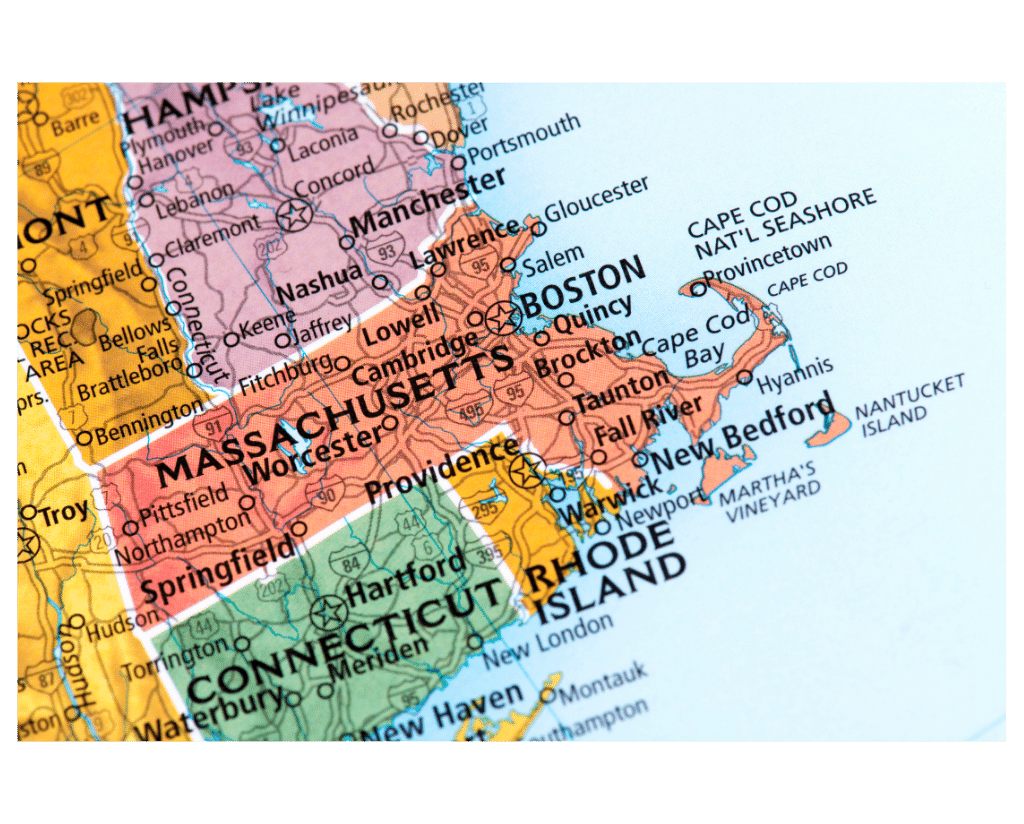
Herring Bank offers cannabis banking services across the Commonwealth, including Boston, Worcester, Springfield, Cambridge, Lowell, Brockton, New Bedford, Quincy, Lynn, Fall River, Newton, Somerville, Framingham, Waltham, Haverhill, Malden, Brookline, Plymouth, Medford, and Taunton. We also operate a statewide armored-courier network to securely manage cash deposits for cannabis companies.


