Your New York Cannabis Bank
New York State Cannabis Banking
Discover the best cannabis and CBD banking in The Empire State with Herring Bank. We’re one of America’s fastest-growing cannabis banks.
Ready to get started?

2026 Cannabis Banking in New York State: Rules, Regulations, and Banking Solutions for CRBs
New York State’s cannabis industry has moved decisively from regulatory uncertainty to full market maturity. Since the Marijuana Regulation and Taxation Act (MRTA) was signed into law on March 31, 2021, the Office of Cannabis Management (OCM) and Cannabis Control Board (CCB) have built one of the most comprehensive — and equity-focused — cannabis regulatory frameworks in the country. Five years in, the results are measurable: over $2.5 billion in cumulative adult-use sales, more than 740 licensed adult-use dispensaries open statewide, and a licensing pipeline that spans cultivation farms in the Hudson Valley and Finger Lakes to dispensaries in Buffalo, Albany, Syracuse, and New York City.
For cannabis-related businesses (CRBs) operating anywhere in the Empire State, reliable banking access remains the single most critical — and most difficult — operational challenge. Herring Bank’s New York State Cannabis Banking Program is purpose-built to solve it.
New York’s Cannabis Market in 2026: By the Numbers
New York’s regulated cannabis market has grown faster than almost any other state program in the country:
- $1.69 billion in retail sales in 2025 alone, with cumulative sales surpassing $2.5 billion since the December 2022 launch
- 745 licensed adult-use dispensaries open statewide as of October 2026, per OCM
- 2,322 adult-use licenses issued spanning cultivation, processing, distribution, retail, and microbusiness categories
- 56% of all adult-use licenses awarded to Social and Economic Equity (SEE) applicants — the highest equity participation rate of any major cannabis market
- ~25,000 jobs supported statewide across the full supply chain
- About $141 million in average monthly retail sales, with New York now ranking among the top cannabis markets nationally alongside California, Illinois, and Massachusetts
Herring Bank’s New York State Cannabis Banking Program
Operated out of our dedicated cannabis banking branch in Colorado Springs, CO, Herring Bank provides compliant, FDIC-insured banking services to licensed cannabis businesses across all of New York State — from dispensaries in Manhattan and Brooklyn to cultivators in the Hudson Valley, processors in the Finger Lakes, and retailers in Buffalo, Albany, Syracuse, and Rochester.
Core Banking Services
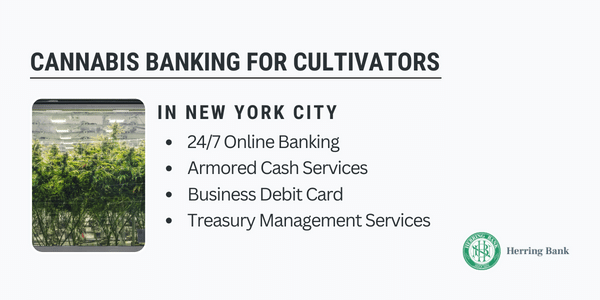
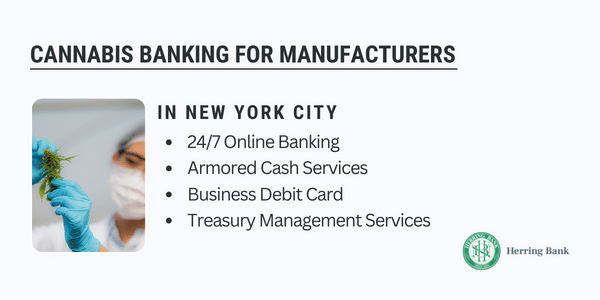
- Business checking and savings accounts with FDIC-insured deposits and transparent, flat-rate pricing — no surprise fees
- 24/7 online and mobile banking for real-time account visibility, transaction management, and operational oversight from anywhere
- Electronic tax payment for New York State excise and local tax filings, keeping your business compliant without cash exposure
- Specialized cash management accounts designed for the volume and velocity of cannabis cash flow
Secure Cash Handling
Operating a licensed cannabis business in New York without armored cash infrastructure is a liability — one that the OCM’s own enforcement data makes clear is exploited by bad actors targeting cash-heavy legal businesses. Herring Bank reduces that exposure through:
- Armored courier partnerships for secure cash pick-up, delivery, and transport across New York State
- Cash management accounts structured to streamline reconciliation, reporting, and BSA/AML compliance
- ATM access through Herring Bank’s network and 55,000+ Allpoint ATMs nationwide
Payroll and Payment Infrastructure
Herring Bank provides the payment infrastructure to run your workforce like any properly capitalized business:
- Direct deposit payroll for all employees — critical for staff retention in a competitive labor market
- Employee deposit accounts, including for workers who struggle to find banks willing to serve cannabis-industry employees
- ACH payments and wire transfers for vendor payments, tax obligations, and intercompany transfers
- Compliance-ready transaction documentation to support OCM inspections and regulatory audits
Growth-Oriented Account Structures
New York’s cannabis market is still expanding — new licenses, new municipalities, new product categories. Herring Bank’s program is built to grow with your business:
- Customized account structures aligned to your specific license type and operational model
- Commercial real estate loans up to 50% loan-to-value for the property your licensed operation runs from
- Dedicated cannabis banking specialists who understand the difference between a CAURD operator, a microbusiness, and a registered organization — and what each one actually needs from a bank
- Industry-adjacent programs for operators with related business lines, including hemp banking and CBD banking
Cannabis Banking in New York State: Why It Remains Difficult
Despite the size and legitimacy of New York’s regulated market, the federal banking gap remains wide open. Although the DEA moved state-licensed medical marijuana to Schedule III in April 2026, adult-use cannabis is still classified as a Schedule I controlled substance under federal law, which means most national banks and credit unions will not open accounts for adult-use CRBs — regardless of how compliant those businesses are under state law.
The SAFER Banking Act — which would create a federal safe harbor for financial institutions serving state-legal cannabis businesses — was reintroduced in June 2026 as the SAFE Banking Act of 2026 (S. 4942 in the Senate and H.R. 9471 in the House) with bipartisan support. It has passed the House in various forms multiple times and cleared the Senate Banking Committee, but as of this writing has not received a full Senate floor vote. A 32-state coalition of attorneys general has formally called on Congress to pass it. Until it does, CRBs across New York State face real consequences: no access to commercial loans, no credit card processing, limited payroll options, and the constant operational risk of running a cash-heavy business.
Herring Bank exists to fill that gap — right now, not when federal reform eventually passes.
2026 Cannabis Banking in New York State: Laws, Licensing and Market Status
New York is now one of the largest adult-use cannabis markets in the country, with more than 700 licensed dispensaries open and a supply chain that runs from Hudson Valley and Finger Lakes farms to storefronts in all five boroughs. For New York cannabis businesses, that scale brings constant regulatory change: new seed-to-sale rules, first license renewals, tax filings at two levels of the supply chain and a federal picture that shifted in 2026. Here is where the rules and the market stand in fall 2026.
New York’s Cannabis Law and Regulators: The MRTA, OCM and the Cannabis Control Board
The Marihuana Regulation and Taxation Act (MRTA), signed March 31, 2021, legalized adult-use cannabis and created the Office of Cannabis Management (OCM), which oversees New York’s medical, adult-use and cannabinoid hemp programs. The five-member Cannabis Control Board, chaired by Jessica García, votes on licenses, renewals and regulations, while OCM, led by Executive Director John Kagia, handles licensing, compliance and enforcement. Every adult-use license must be renewed every two years, and OCM asks licensees to file renewal applications at least 60 days before their license expires.
License Types and Counts
As of the Cannabis Control Board’s August 2026 meeting, New York had issued 2,322 adult-use licenses, 56% of them to Social and Economic Equity (SEE) applicants:
- Processors: 574 licenses for extraction, infusion and packaging
- Retail dispensaries: 537 licenses, plus 360 Conditional Adult-Use Retail Dispensary (CAURD) licenses issued to justice-involved entrepreneurs
- Microbusinesses: 328 small, vertically integrated operators
- Cultivators: 275 licenses, tiered by canopy size and grow method
- Distributors: 248 licenses moving product from producers to retailers
New York keeps the supply chain largely separated, so most retailers cannot also hold cultivation, processing or distribution licenses. The main exceptions are microbusinesses and the registered organizations from the medical program. That structure means more businesses, more wholesale invoices and more business-to-business payments that need to move through a bank rather than in cash.
New York Cannabis Taxes in 2026
Adult-use purchases carry a 13% retail excise tax: 9% for the state and 4% for localities. Since June 1, 2024, the old per-milligram THC potency tax has been replaced by a flat 9% tax on adult-use cannabis product sales at the distributor level, and since December 1, 2024 the Department of Taxation and Finance has administered it. Medical cannabis sold by registered organizations carries a 3.15% excise tax on gross receipts.
Where New York’s Cannabis Market Stands in 2026
Licensed retailers sold $1.69 billion of adult-use cannabis in 2025, and 287 stores opened that year alone, according to OCM’s February 2026 market update. Openings kept coming in 2026. New York had 582 open dispensaries in February and 705 in August, and OCM’s dispensary verification list showed more than 740 in mid-October. At the September 3, 2026 Board meeting, OCM revised its 2026 sales forecast from $2.6 billion to $2 billion and its 2027 forecast from $3.7 billion to $2.6 billion. It cited two causes: a switch to more accurate Metrc data and retail price declines of 10% to 15%, while unit sales had grown 39% since January. Licensed cultivation canopy rose from 9.1 million to 12 million square feet between March and August 2026.
Key 2026 Regulatory Changes for New York Licensees
- Metrc seed-to-sale tracking: OCM is phasing in statewide Metrc tracking, including item-level identification at retail. The state budget set aside $10 million to cover Metrc tag costs for licensees beginning September 1, 2026.
- First renewal cycle: OCM is processing the program’s first wave of renewals. Community Impact Plans filed before the 2028 renewal cycle are being treated as informational while OCM builds a scoring framework.
- Reporting: cultivators had to file annual resource reports through the PowerScore platform by August 31, 2026, and OCM moved its retail sales reporting to a quarterly cadence.
- Siting reviews: the Board still weighs school proximity and neighborhood concentration when it approves new storefronts, and it tabled a Bronx retail license in September 2026 to gather more information on school proximity.
Federal Changes That Affect New York Cannabis Businesses
Effective April 28, 2026, the U.S. Department of Justice and DEA moved FDA-approved marijuana products and marijuana subject to a qualifying state medical license from Schedule I to Schedule III. For New York, that covers medical cannabis dispensed by the registered organizations (ROs) in the state’s medical program, which gain a DEA registration pathway and are expected to fall outside Section 280E of the tax code going forward. Adult-use marijuana, which is what most New York dispensaries sell, remains in Schedule I while the DEA’s broader rescheduling proceeding continues, so adult-use licensees still carry 280E and the full federal banking burden.
Federal banking law has not changed. The SAFE Banking Act of 2026 (S. 4942), with a House companion, H.R. 9471, was introduced in June 2026 and remains in committee. Until Congress acts, cannabis businesses need a bank that follows FinCEN guidance for marijuana-related businesses, including enhanced due diligence, ongoing monitoring and Suspicious Activity Report (SAR) filing.
New York’s cannabinoid hemp processors and retailers face their own deadline: the federal hemp redefinition enacted in November 2025 counts total THC and excludes synthesized cannabinoids. The synthetic-cannabinoid exclusion begins November 12, 2026, and after a September 2026 extension most other provisions take effect December 11, 2026. Herring Bank offers dedicated hemp banking and CBD banking for operators working through the change.
What This Means for Banking a Cannabis Business in New York State
New York’s market is bigger and more competitive than it was a year ago. Prices are falling, renewals are under way and OCM’s Metrc data now shows regulators what is moving through the supply chain. Herring Bank’s New York State cannabis banking program gives licensed cultivators, processors, distributors, dispensaries, CAURD operators, microbusinesses and delivery licensees compliant operating accounts, plus account documentation that lines up with OCM licensing and Metrc records for BSA/AML review. We also offer cash pickup and delivery through our preferred armored courier, and payroll, ACH, wires and electronic payment of New York’s adult-use cannabis taxes. Ready to talk about New York cannabis banking? Call 877-873-0079 or request a call back.
Serving Cannabis Businesses Across New York State
Herring Bank serves CRBs in every region of New York State, including the state’s major cannabis markets:
New York City — The largest single cannabis market in the state, with more than 300 licensed dispensaries across the five boroughs (per OCM’s dispensary verification list, October 2026) contributing millions in monthly retail sales. See our dedicated NYC cannabis banking page for borough-specific information on serving Manhattan, Brooklyn, Queens, the Bronx, and Staten Island.
Buffalo and Western New York — A growing retail market with dispensaries now established across Erie and Niagara counties, including delivery services extending into Rochester. Western New York’s agricultural base also supports cultivation operations that require banking infrastructure.
Albany and the Capital Region — Home to regulatory activity (the OCM headquarters is in Albany) and a growing number of licensed dispensaries. Capital Region operators benefit from proximity to state regulators — but still face the same federal banking barriers as every other CRB in New York.
Rochester and the Finger Lakes — One of New York’s most active cultivation regions, with outdoor and mixed-light grows benefiting from the region’s agricultural climate. Cultivators and processors here have complex, multi-tier banking needs that most institutions can’t support.
Syracuse and Central New York — A developing retail and distribution market that is scaling rapidly as new licenses come online.
Hudson Valley and the Catskills — A mix of boutique cultivators, microbusinesses, and lifestyle-oriented dispensaries catering to both local residents and cannabis tourism traffic.
Long Island — A densely populated suburban market with significant retail demand and delivery operations serving communities across Nassau and Suffolk counties.
Why New York CRBs Choose Herring Bank
We don’t learn on the job. Herring Bank has been providing cannabis banking programs in legally complex state markets for years — with active programs in California, Colorado, Washington State, and beyond. That experience means our compliance program is tested, our processes are built for the realities of cannabis operations, and our team understands what CRBs actually need from a banking relationship.
For New York cannabis businesses, the question isn’t whether you need a banking partner — it’s whether your current one can actually support the complexity of operating a licensed cannabis business in one of the most regulated markets in the country. Herring Bank can.