

Kentucky Cannabis Banking
Explore premier banking solutions for Cannabis and CBD enterprises in the Blue Grass state, with Herring Bank, one of the leading cannabis banks.
Ready to get started?

Explore Kentucky Cannabis Banking Solutions
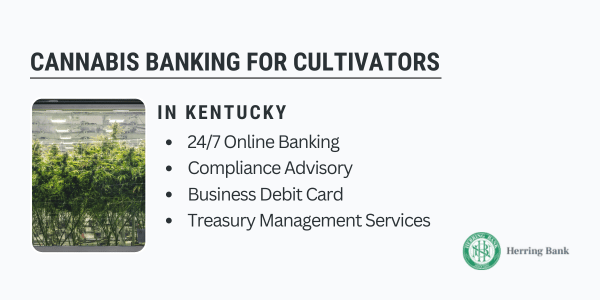
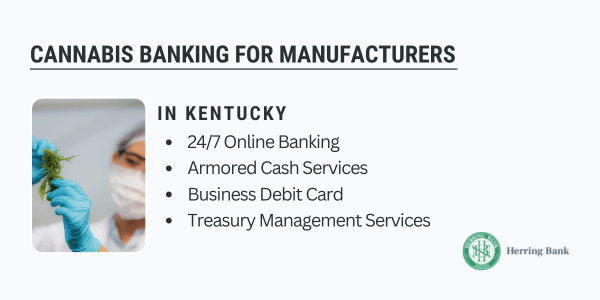
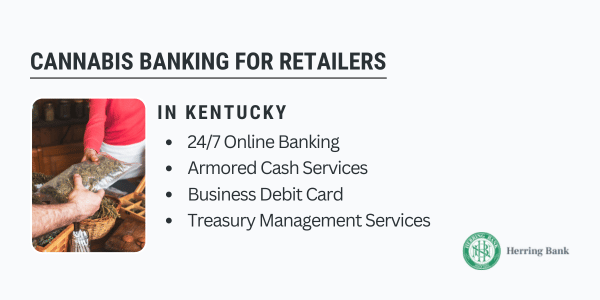
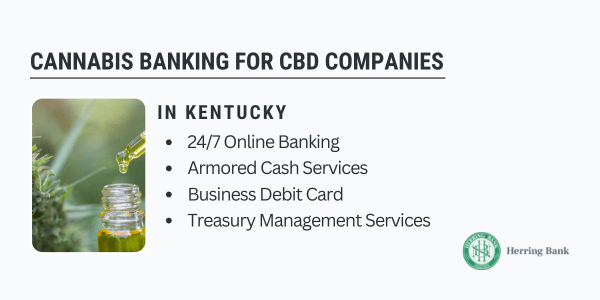
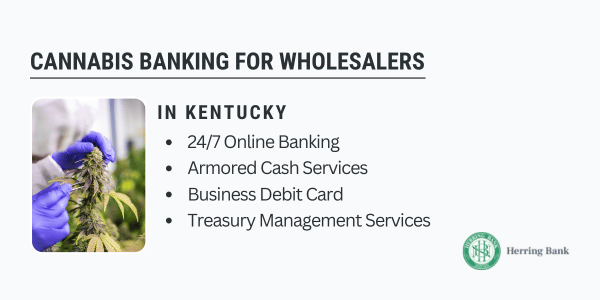
Tailored Cannabis Banking Services for Kentucky

2026 Cannabis Banking in Kentucky: Laws, Licensing and Market Status
Kentucky’s medical cannabis program is no longer a plan on paper. Medical cannabis became legal on January 1, 2025, the first legal sale took place in December 2025, and by October 2026 dispensaries were open in every licensing region of the state. For cultivators, processors, producers, dispensaries and testing labs, that makes Kentucky cannabis banking an everyday need: daily deposits, payroll, vendor payments and tax obligations all have to run through a bank that understands marijuana-related business (MRB) compliance.
Kentucky’s Medical Cannabis Law: SB 47 and KRS Chapter 218B
Gov. Andy Beshear signed Senate Bill 47 on March 31, 2023, legalizing medical cannabis starting January 1, 2025. House Bill 829, signed April 17, 2024, moved the licensing timeline up by six months, and the Office of Medical Cannabis began taking business applications on July 1, 2024. The Office, part of the Cabinet for Health and Family Services (CHFS), administers the program under KRS Chapter 218B and oversees licensed businesses from opening through daily operations, under the regulations published by KYMedCan. Key rules for Kentucky cannabis businesses:
- License types: cultivators (licensed in size tiers), processors, producers, dispensaries and safety compliance facilities (testing labs).
- Lottery licensing: the state received 4,998 business applications, including 4,075 for dispensaries, and awarded licenses in oversubscribed categories by lottery. Dispensary licenses are allocated across 11 regions to spread access statewide.
- Products: edibles, oils, tinctures, vapes and raw plant material are allowed, but SB 47 prohibits smoking raw plant material, which must be labeled “not intended for consumption by smoking.” Cardholders under 21 may not buy or use vaping products.
- Purchase limits: a 30-day supply is capped at 112 grams of raw plant material, 28 grams of concentrate or 3,900 mg of THC in products such as edibles.
- Patients: qualifying conditions include cancer, chronic or severe pain, epilepsy and seizure disorders, multiple sclerosis and spasticity, chronic nausea and PTSD. A June 2, 2026 executive order added 15 more, including sickle cell anemia, ALS, Crohn’s disease and Parkinson’s disease. A registry ID card costs $25, per the Office of Medical Cannabis.
- Adult-use remains illegal: recreational marijuana is not legal in Kentucky.
Where Kentucky’s Medical Cannabis Market Stands in 2026
Kentucky’s first legal sale took place on December 13, 2025, when The Post Dispensary opened in Beaver Dam. Openings picked up through 2026 as cultivators and processors brought supply online. According to the governor’s office on October 16, 2026:
- 26 dispensaries are operating, with at least one open in all 11 licensing regions. Sunnyside Dispensary in Prestonsburg, the first in the Mountain Region, opened on October 12, 2026.
- 46 licensed medical cannabis businesses are up and running across all license types.
- More than 28,000 Kentuckians have been approved for medical cannabis cards.
- More than 500 practitioners are registered to certify patients.
The state awarded 48 dispensary licenses in its 2024 lotteries, so roughly half of Kentucky’s licensed dispensaries have yet to open. Each opening means another business that needs an operating account, cash logistics and payroll before its first sale.
Kentucky Hemp and THC Beverage Rules
Kentucky also regulates intoxicating hemp products. Senate Bill 202, signed March 25, 2025, caps cannabis-infused beverages at 5 mg of intoxicating cannabinoids per 12-ounce serving, applies alcohol-style age limits, and gives the Department of Alcoholic Beverage Control authority over distribution and retail sales, with ABC regulations due by July 1, 2026. Hemp businesses also face the federal hemp redefinition, which moves to a total-THC standard with most provisions taking effect December 11, 2026. Herring Bank offers hemp banking and CBD banking for Kentucky operators.
Federal Changes That Affect Kentucky Cannabis Businesses
Effective April 28, 2026, the Justice Department and DEA moved FDA-approved marijuana products and marijuana subject to a qualifying state medical license from Schedule I to Schedule III. Because every Kentucky licensee operates under the state’s medical program, the whole Kentucky market is within the order, which creates a DEA registration pathway and is expected to take licensed medical operators out of Section 280E going forward. Federal banking law has not changed: the SAFE Banking Act of 2026 (S. 4942) remains in committee, so banks still follow FinCEN’s guidance for marijuana-related businesses, including enhanced due diligence and SAR filing.
What This Means for Banking a Cannabis Business in Kentucky
A new medical market growing one opening at a time is where an experienced cannabis bank makes the biggest difference. Herring Bank helps Kentucky cultivators, processors, producers, dispensaries and testing labs open compliant operating accounts before opening day, document Office of Medical Cannabis licensing for BSA/AML review, manage cash with pickup and delivery through our preferred armored courier, and run payroll, ACH, wires and electronic tax payments. Ready to talk about Kentucky cannabis banking? Call 877-873-0079 or request a call back.
Financial Services for Legal Cannabis Businesses
- Checking Accounts: In addition to debit cards, Herring Bank provides checking accounts tailored to the needs of cannabis businesses. These accounts allow for secure deposit and withdrawal of funds, electronic payments, and other essential financial transactions.
- Online and Mobile Banking: CRBs can manage their accounts and transactions remotely through Herring Bank’s online and mobile banking platforms. This access ensures that businesses can monitor their financial status in real-time and perform necessary transactions seamlessly.
Compliance and Safety
To provide these services, Herring Bank ensures strict compliance with both state regulations and federal guidelines set by the Financial Crimes Enforcement Network (FinCEN). This includes conducting thorough due diligence, monitoring transactions for suspicious activity, and filing necessary reports to regulatory authorities.
Can Cannabis Companies accept Debit Cards?
Herring Bank provides comprehensive debit card services for cannabis-related businesses (CRBs) in Kentucky, enabling secure and convenient transactions for both businesses and their customers. By offering this service, Herring Bank helps cannabis companies transition away from cash-only operations, significantly reducing the risks associated with handling large amounts of cash. Additionally, Herring Bank offers robust merchant processing solutions tailored to the unique needs of the cannabis industry, ensuring seamless and efficient financial operations.
What types of Cannabis Companies does Herring Bank serve?
- Dispensaries: Retail stores where consumers can purchase cannabis products for legal use.
- Cultivators: Businesses involved in the growing and harvesting of cannabis plants.
- Processors: Companies that process raw cannabis into various products such as oils, edibles, tinctures, and other consumable forms.
- Producers: Businesses that produce and package cannabis products for sale to dispensaries and consumers.
- Testing Facilities: Laboratories that test cannabis products for quality control, ensuring they meet regulatory standards.
- Transport and Delivery Services: Companies that handle the transportation and delivery of cannabis products from cultivators and processors to dispensaries and consumers.
- Ancillary Businesses: Businesses that provide support services to the cannabis industry, such as equipment suppliers, marketing agencies, legal and compliance consultants, and more.
What cities in Kentucky does Herring Bank provide Cannabis Banking?
Herring Bank provides Cannabis Banking services to CRBs in: Louisville, Lexington-Fayette, Bowling Green, Owensboro, Covington, Georgetown, Richmond, Florence, Hopkinsville, Nicholasville, Independence, Jeffersontown, Frankfort, Henderson, Paducah, Radcliff, Ashland, Erlanger, Madisonville, Winchester


