

Your Utah Cannabis Bank
Utah Cannabis Banking
Grow your business with cannabis banking in Utah. Herring Bank is one of the country’s leading cannabis banks, with compliant business accounts, cash management and compliance support for Utah’s medical cannabis pharmacies, cultivators and processors.
Ready to get started?

Banking Solutions for Utah Cannabis Companies
Herring Bank’s Cannabis Banking program in Utah is built for the state’s medical cannabis industry: cultivators, processors, independent testing labs, couriers and medical cannabis pharmacies licensed by the Utah Department of Agriculture and Food and the Center for Medical Cannabis. We provide business checking and savings accounts, 24/7 online banking, payment processing, electronic tax payments and payroll tools, so Utah operators can run their finances like any other business while meeting the documentation standards regulators and bank examiners expect.
Cash is still a reality for cannabis retail. We connect our clients with our preferred armored courier for pickup and delivery, so sales from Salt Lake City, West Valley City, Provo, Ogden, St. George and Logan reach the bank without staff driving deposits across town. Deposits are reconciled against the state’s seed-to-sale records and the Utah Department of Agriculture and Food and the Center for Medical Cannabis licensing as part of our ongoing monitoring. We also serve cannabis businesses in Nevada, Colorado and Arizona.
Herring Bank also serves the people behind the licenses. Owners and employees of licensed Utah cannabis businesses can qualify for cannabis home loans through our mortgage team, and our Cannabis Business Advisory service helps new licensees set up accounts, controls and reporting from day one.
Financial Services for Utah Cannabis Businesses
Utah’s cannabis businesses, from the state’s licensed pharmacies and couriers to the cultivators and processors behind them, have financial needs that most banks will not touch. Herring Bank meets those needs with accounts designed for licensed cannabis operations, so cash flow, vendor payments and tax remittance run on schedule.
Our digital tools matter as much as our accounts. Online and mobile banking give Utah operators round-the-clock visibility into every location, while debit cards, check services and wire access put the full range of business banking within reach. Our services for Utah cannabis businesses are listed below.
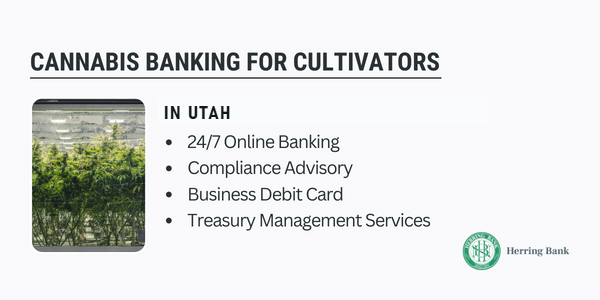
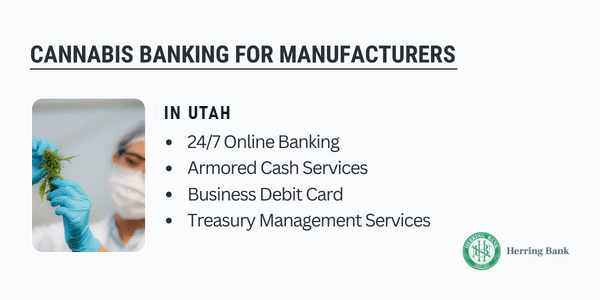
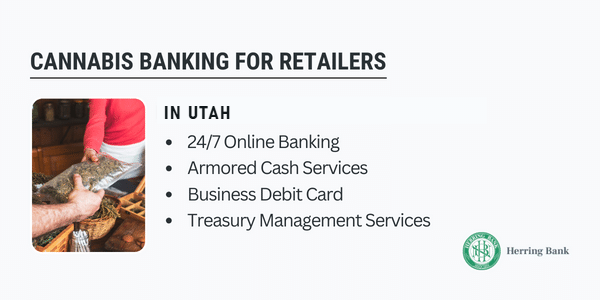
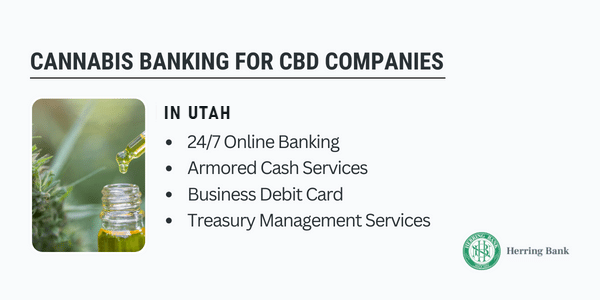
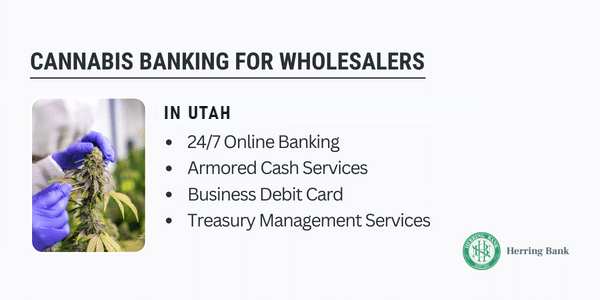
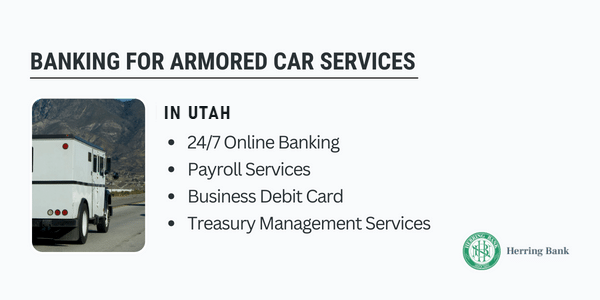
Marijuana Banking in Utah
Herring Bank’s Cannabis Banking Program for Utah is a purpose-built platform for a disciplined medical market with a small number of high-volume pharmacies. About 112,000 active Utah patients buy from roughly 17 licensed medical cannabis pharmacies, and sales reached roughly $175 million in 2025. Operators who want to protect their margins need banking that is both efficient and compliant.
Our program gives Utah cannabis enterprises specialized checking and savings accounts, 24/7 online banking for multi-location oversight, payment processing for customer transactions and electronic tax payments for Utah’s per-purchase state fee and ordinary business taxes. Recognizing how much cash still moves through dispensaries, we pair cash management accounts with secure pickup and delivery through our preferred armored courier.
To support your workforce, Herring Bank provides employee accounts, direct deposit payroll, ACH payments and wire transfers, so paying budtenders, growers, vendors and the state is routine. Every relationship is guided by FinCEN’s BSA/AML expectations for marijuana-related businesses, giving Utah operators a durable financial foundation.
2026 Cannabis Banking in Utah: Laws, Licensing, Taxes and Market Status
Utah voters approved Proposition 2 in November 2018, the Legislature replaced it with the Utah Medical Cannabis Act weeks later, and the first medical cannabis pharmacy opened in March 2020. The program is deliberately small on the retail side and medically supervised, with pharmacists on staff and electronic verification at every sale. Recreational marijuana remains illegal. In 2026 the program is in the middle of a regulatory handoff that every Utah licensee should be tracking.
Who Regulates Cannabis in Utah
Cultivators, processors, testing labs and couriers are licensed by the Utah Department of Agriculture and Food (UDAF), while the Center for Medical Cannabis in the Department of Health and Human Services has run the patient program and pharmacy licensing. Key rules for Utah operators:
- 2026 transition: HB 389 and SB 121, passed in the 2026 session and effective May 6, 2026, consolidate the program under UDAF. Duties may move as early as July 1, 2026, with the full transition due by January 1, 2027.
- Pharmacy licenses: the state caps medical cannabis pharmacies, and HB 54 added two rural licenses, one awarded in 2025 and one in 2026, bringing the total to about 17.
- Product rules: flower may be sold for vaporization but not smoked; low-THC products may now be purchased at pharmacies under the 2026 changes.
- Seed-to-sale and verification: licensees use the state’s inventory control system, and pharmacies verify each patient’s card and limits through the electronic verification system at the point of sale.
Utah Cannabis Taxes in 2026
Medical cannabis is exempt from Utah sales tax. Instead, patients pay a state fee on each purchase that funds the program, and the 2026 legislation allows UDAF to adjust that fee. Licensees pay ordinary state and local business taxes and remain subject to federal Section 280E rules, so clean, reconciled deposit and cost records matter.
Utah’s Cannabis Market in 2025 and 2026
Utah had about 112,000 active patients as of March 31, 2026, and 1,028 registered recommending providers in mid-2026 according to the state’s monthly reports. Sales reached roughly $175 million in 2025, up from about $157 million in 2024, with vape cartridges overtaking flower as the largest category. With only about 17 pharmacies statewide, each location handles unusually high volume, which makes cash logistics, payroll and vendor payments a daily operational issue.
Federal Changes That Affect Utah Cannabis Businesses
A Justice Department order effective April 28, 2026 moved marijuana covered by a qualifying state medical license, and FDA-approved marijuana products, to Schedule III. Because every licensee in Utah operates under the state medical program, the order covers them, creating a DEA registration pathway and the expectation that licensed medical activity falls outside Section 280E going forward. The SAFE Banking Act of 2026 was introduced in June 2026 and remains in committee, so banks continue to follow FinCEN’s 2014 guidance for marijuana-related businesses. Utah hemp and CBD businesses should also prepare for the federal hemp redefinition, most of which takes effect December 11, 2026.
What This Means for Banking a Cannabis Business in Utah
Herring Bank is a compliance-first banking partner for Utah cannabis-related businesses. We help pharmacies, cultivators, processors, labs and couriers from Salt Lake City and Provo to St. George open compliant business checking and savings accounts, document UDAF and Center for Medical Cannabis licensing for BSA/AML review, reconcile deposits with inventory records, handle cash through pickup and delivery with our preferred armored courier, and run payroll, ACH, wires and electronic tax payments. We also serve cannabis businesses in Nevada, Colorado and Arizona. Ready to talk about Utah cannabis banking? Call 877-873-0079 or request a call back.
Frequently Asked Questions (Utah)
Is recreational marijuana legal in Utah?
No. Utah is a medical-only state under the Utah Medical Cannabis Act. Patients buy from licensed medical cannabis pharmacies with a pharmacist on staff.
Who regulates medical cannabis businesses in Utah?
The Utah Department of Agriculture and Food licenses cultivators, processors, labs and couriers, and the Center for Medical Cannabis has run the patient program and pharmacies. 2026 legislation consolidates the program under UDAF, with the full transition due by January 1, 2027.
What taxes apply to medical cannabis in Utah?
Medical cannabis is exempt from sales tax. Patients pay a state fee on each purchase, which UDAF may adjust under the 2026 changes, and licensees pay ordinary business taxes.
How many medical cannabis pharmacies does Utah have?
About 17. The state caps pharmacy licenses, and HB 54 added two rural licenses, one awarded in 2025 and one in 2026.
How large is Utah’s medical cannabis market?
Utah had about 112,000 active patients as of March 2026 and sales of roughly $175 million in 2025, with vape cartridges now the largest product category.
Can Utah cannabis businesses use banks, and what is the federal status?
Yes. Herring Bank serves Utah cannabis-related businesses under FinCEN’s 2014 guidance, with enhanced due diligence and ongoing monitoring. Since April 28, 2026, marijuana covered by a qualifying state medical license has been in Schedule III, which covers every licensee in a medical-only state. The SAFE Banking Act of 2026 (S. 4942) is still in committee.


