

Your Colorado Cannabis Bank
Colorado Cannabis Banking
Looking for reliable cannabis banking in the Centennial State? Herring Bank offers a full suite of banking services tailored specifically to Colorado cannabis-related businesses (CRBs).
Ready to get started?

Explore Colorado Cannabis Banking Solutions
Empowering Colorado’s Cannabis Industry with Secure, Compliant Banking Solutions
Colorado’s legal cannabis businesses face unique financial challenges—from stringent compliance demands to cash-intensive operations. Herring Bank rises to meet these needs with specialized cannabis banking services designed to secure, streamline, and scale your enterprise. Discover how our tailored solutions help businesses thrive while prioritizing safety, innovation, and growth.
Comprehensive Services Built for Cannabis Success
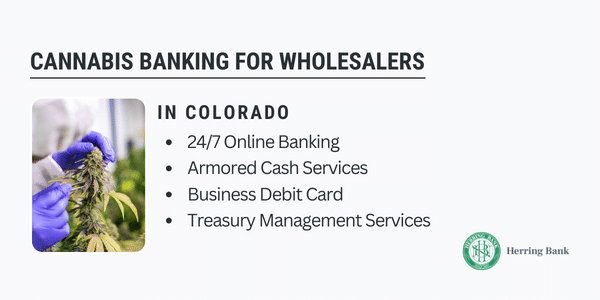
- 24/7 Digital Banking & Financial Control: Manage accounts, process payments, and handle taxes anytime, anywhere. Our intuitive online and mobile platforms ensure real-time oversight of cash flow, reducing errors and enhancing operational efficiency.
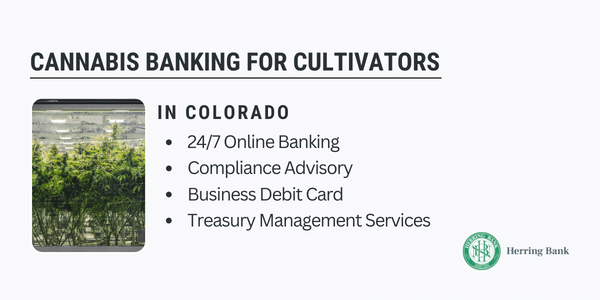
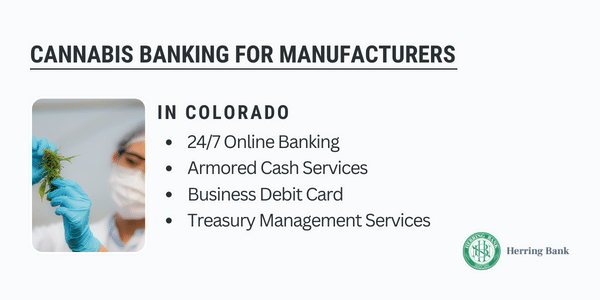
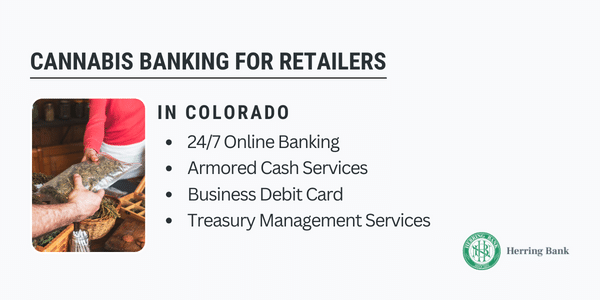
- Advanced Cash Management: Minimize risk with our expanding network of armored couriers, offering secure cash transport and deposit solutions tailored to high-volume industries.
- FDIC-Insured Growth Opportunities: Safeguard your profits with investment options that combine security and growth potential, backed by federal deposit insurance.
- Seamless Payroll & Payments: Simplify payroll with flexible options like ACH (Automated Clearing House) and wire transfers, ensuring timely compensation and vendor transactions.
Compliance & Security at the Core
Herring Bank prioritizes adherence to federal and state regulations, including FinCEN’s BSA/AML guidance, while tracking federal proposals such as the Safe Banking Act. Our solutions reduce reliance on cash, mitigate legal risks, and ensure transparent financial practices—so you can focus on growth without compromising compliance.
Strategic Support for Scaling Businesses
Whether expanding operations, acquiring property, or entering new markets, Herring Bank offers:
- Customized Account Structures to align with your business model.
- Cannabis Real Estate Loans up to 50% loan-to-value to buy or refinance the property your business operates from.
- Dedicated Advisory Services to navigate the evolving cannabis landscape.
Why Herring Bank?
As a trusted financial partner for Colorado’s cannabis sector, Herring Bank combines deep industry expertise with cutting-edge technology. We’re not just a bank—we’re your ally in building a resilient, compliant, and profitable business.
Elevate Your Cannabis Enterprise with Banking Solutions That Grow With You.
Specialized Financial Services for Colorado Cannabis Businesses
Cannabis businesses in Colorado navigate a unique set of financial hurdles, necessitating tailored services that match their specific operational needs. Herring Bank distinguishes itself by offering focused financial solutions to licensed cannabis-related businesses throughout Colorado, encompassing dispensaries, cultivation facilities, and ancillary enterprises. By providing business savings and checking accounts crafted for the nuances of the cannabis industry, Herring Bank plays a pivotal role in streamlining cash flow management, secure cash transportation via armored couriers, and ensuring compliant financial transaction processing.
The bank’s commitment to delivering a full suite of banking solutions is particularly apparent in its digital offerings and alignment with evolving regulations. Colorado’s cannabis market, which generated $1.5 billion in sales in 2023 (and about $1.32 billion in 2025 as prices fell, per the Colorado Department of Revenue, still one of the nation’s most mature markets), relies heavily on advanced financial infrastructure. Herring Bank’s 24/7 online and mobile banking platforms remain critical for real-time financial oversight, enabling businesses to manage payroll via ACH/wire transfers, submit taxes electronically, and mitigate risks associated with cash-heavy operations.
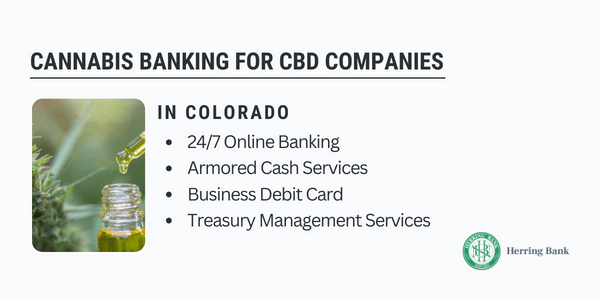
Recent federal and state regulatory developments continue to shape the financial landscape for cannabis businesses. Efforts to shield financial institutions serving state-legal cannabis operators from federal penalties have gained bipartisan momentum, addressing public safety risks tied to cash-only models and potentially expanding access to credit lines and insurance. State-level initiatives further bridge gaps between federal restrictions and local businesses, fostering fintech innovations and clearer compliance frameworks. Federal hemp rules are tightening as well: the November 2025 federal funding law redefines hemp on a total-THC basis and caps final hemp-derived products at 0.4 mg total THC per container, with most provisions now taking effect December 11, 2026—raising enhanced due diligence expectations for financial institutions serving hemp and CBD businesses.
Herring Bank complements these advancements with services like FDIC-insured investment opportunities, compliance-focused cash management, and employee payroll solutions, ensuring cannabis enterprises operate securely within Colorado’s tax-funded ecosystem (more than $3.1 billion in cumulative marijuana tax revenue since 2014). Augmenting its core offerings, the bank also provides debit cards, check services, and armored courier partnerships in key cities like Denver and Colorado Springs, aligning with 2026’s emphasis on risk mitigation, BSA/AML compliance and operational efficiency.
Marijuana Safe Banking in Colorado
Business Checking Accounts and Banking Services for Colorado Cannabis Companies
Herring Bank is proud to offer a dedicated Cannabis Banking Program for Colorado, specifically designed to address the unique financial challenges faced by cannabis businesses in the state. With Colorado’s cannabis industry continuing to thrive, generating $1.5 billion in sales in 2023 (and about $1.32 billion in 2025), the need for reliable and compliant banking solutions has never been greater. Our program provides cannabis companies with specialized business checking and savings accounts, enabling efficient fund management, secure cash handling, and seamless financial operations.
At the core of our offering is a focus on business checking accounts tailored to the cannabis industry. These accounts are designed to help dispensaries, cultivators, and ancillary businesses manage their day-to-day finances with ease. Coupled with 24/7 online and mobile banking, cannabis companies can monitor transactions, process payments, and submit taxes electronically—all while maintaining compliance with state and federal regulations. This digital accessibility ensures businesses can operate efficiently, no matter where they are.
Recognizing the cash-intensive nature of the industry, Herring Bank provides secure cash management solutions, including armored courier services, to minimize risks associated with cash handling. Our cannabis business accounts also support payroll management through direct deposit, ACH payments, and wire transfers, streamlining workforce operations and reducing administrative burdens.
To further empower growth, Herring Bank offers additional financial tools such as debit cards, check services, and investment opportunities, all tailored to the unique needs of cannabis enterprises. These services are designed to provide a strong financial foundation, helping businesses navigate the complexities of the industry while maximizing their potential for success.
Herring Bank’s Cannabis Banking Program is more than just a suite of services—it’s a commitment to supporting Colorado’s cannabis businesses with the financial infrastructure they need to thrive in a competitive and ever-evolving market.

2026 Cannabis Banking in Colorado: Laws, Licensing and Market Status
Colorado is one of the oldest and most mature legal cannabis markets in the country, and it is also one of the most tightly regulated. Medical marijuana has been legal since voters approved Amendment 20 in 2000, adult-use (retail) marijuana since Amendment 64 in 2012, and licensed retail stores have been open since January 2014. For dispensaries, cultivators, manufacturers, testing labs, transporters and the vendors that serve them, Colorado cannabis banking means working with a bank that understands both state rules and federal BSA/AML expectations for marijuana-related businesses (MRBs).
Who Regulates Cannabis in Colorado
The Marijuana Enforcement Division (MED), part of the Colorado Department of Revenue, licenses and regulates every medical and retail marijuana business in the state, while cities and counties decide whether to allow marijuana businesses at all and set local zoning, licensing and tax rules. Key rules that shape a Colorado cannabis business in 2026:
- License types: stores, cultivation facilities, product manufacturers, testing facilities, transporters and, where local governments allow them, delivery and hospitality businesses, with separate medical and retail licenses.
- Two-year licenses: under SB24-076, effective August 7, 2024, new and renewed marijuana business licenses run for two years instead of one. The same law lets retail stores sell certain non-infused food and beverage items and hemp products alongside marijuana.
- Seed-to-sale tracking: every plant and package is tracked in Metrc. In August 2026 the Department of Revenue re-awarded the statewide tracking contract to Metrc and announced tag options without RFID technology, to be phased in over the following year (MED Industry Bulletin 26-08).
- 2026 rule changes: the State Licensing Authority adopted its 2026 rule revisions on September 10, 2026, with an effective date of November 1, 2026, alongside expanded residual-solvents testing requirements (MED rules).
- Point-of-sale requirements: stores must post pregnancy warnings and hand out MED’s educational material with concentrate purchases.
Colorado Cannabis Taxes
Colorado layers several state taxes on marijuana: a 15% retail marijuana sales tax, a 15% retail marijuana excise tax on wholesale sales and transfers of retail marijuana, and the 2.9% state sales tax, plus any local marijuana and sales taxes. Those layers make electronic tax payments and clean recordkeeping a core part of running a Colorado marijuana business.
Colorado’s Cannabis Market in 2025 and 2026
According to the Colorado Department of Revenue, medical and retail marijuana stores sold about $1.32 billion ($1,315,678,364) in 2025, well below the roughly $1.5 billion the state recorded in 2023 as wholesale and retail prices fell. Cumulative sales since January 2014 have passed $18.2 billion, and the state has collected more than $3.12 billion in marijuana tax and fee revenue since February 2014. Lower prices and flat demand put pressure on margins, which makes cash control, vendor payments and tax planning even more important for Colorado operators.
Colorado Hemp and THC Products
Colorado regulates hemp-derived cannabinoids under SB23-271, which created a state framework overseen by the Department of Public Health and Environment and caps hemp-derived products at 1.75 milligrams of THC per serving, with intoxicating products kept inside the regulated marijuana system. After Congress redefined hemp in November 2025, lawmakers considered loosening the state rules: SB26-164 would have raised the cap for THC beverages to 10 milligrams and allowed sales wherever alcohol is sold, but its sponsor pulled the bill in April 2026. The federal hemp redefinition, which counts total THC including THCA and bars synthesized cannabinoids, is now scheduled to take most of its effect on December 11, 2026 (Congressional Research Service). Herring Bank also offers dedicated Colorado hemp banking.
Federal Changes That Affect Colorado Cannabis Businesses
Effective April 28, 2026, the U.S. Department of Justice moved FDA-approved marijuana products and marijuana covered by a qualifying state medical license to Schedule III, with a DEA registration pathway for state medical licensees. Colorado retail (adult-use) marijuana remains in Schedule I, and Section 280E still applies to adult-use sales, so businesses holding both medical and retail licenses need to keep those revenue streams clearly separated. A broader DEA rescheduling decision is still pending.
Federal banking law has not changed. The SAFE Banking Act of 2026 (S. 4942) was introduced in June 2026 and remains in committee, and in July 2025 Colorado’s attorney general joined a bipartisan coalition urging Congress to act. Until it does, banks serve Colorado cannabis businesses under FinCEN’s 2014 guidance, which calls for enhanced due diligence, ongoing monitoring and marijuana-specific Suspicious Activity Report (SAR) filings.
What This Means for Banking a Cannabis Business in Colorado
Colorado’s market rewards operators who run a tight, well-documented business. Herring Bank works with Colorado dispensaries, cultivators, manufacturers, testing labs, transporters and ancillary businesses to open compliant business checking and savings accounts, document MED and local licensing for BSA/AML review, move cash safely with pickup and delivery through our preferred armored courier, and run payroll, ACH, wires and electronic tax payments, including the state’s retail marijuana sales and excise taxes. Ready to talk about Colorado cannabis banking? Call 877-873-0079 or request a call back.
Frequently Asked Questions
How often do Colorado cannabis businesses need to renew licenses?
As of August 7, 2024, cannabis business licenses in Colorado are valid for two years under SB24-076, reducing administrative burden compared to annual renewals.
Can Colorado dispensaries sell food and hemp products?
Yes. Retail marijuana stores may sell non-infused food and beverage items and hemp-derived products, but sales are capped at 20% of annual gross revenue, per SB24-076 and Colorado MED guidance.
What are the current social equity requirements?
The Colorado MED revised qualifications for social-equity applicants. Residency requirements were shortened to five years in disproportionately impacted areas, with new eligibility options including participation in state or federal assistance programs.
Are RFID tags still required in Colorado?
Yes. The MED clarified that Metrc plant tags remain mandatory for inventory tracking. Under the new Metrc contract announced in August 2026, plant and package tag options without RFID technology are being phased in, so check current MED industry bulletins before ordering tags.
What is the status of the SAFE Banking Act?
The SAFE Banking Act of 2026 (S.4942) was not enacted in the 118th Congress. Its successor, the SAFE Banking Act of 2026 (S.4942), was reintroduced in June 2026 and remains in committee. In July 2025, a bipartisan coalition of state attorneys general, including Colorado’s, called for passage, but no federal safe harbor exists yet.


