Your Michigan Cannabis Bank
Michigan Cannabis Banking
Ready to get started?

Banking Solutions for Michigan Cannabis Companies
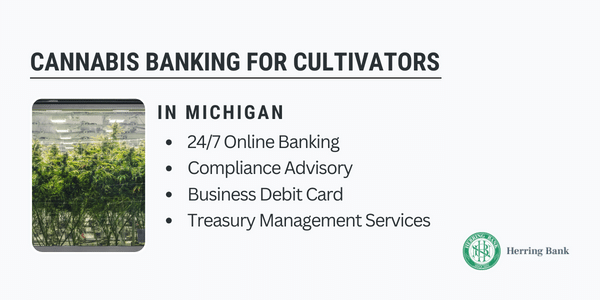
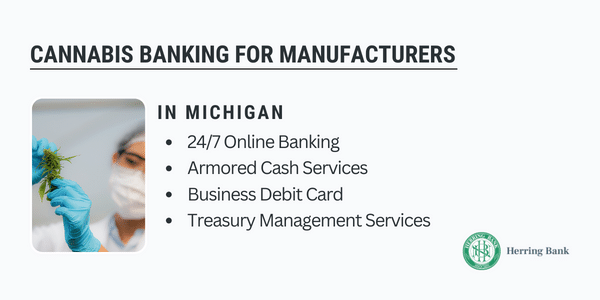
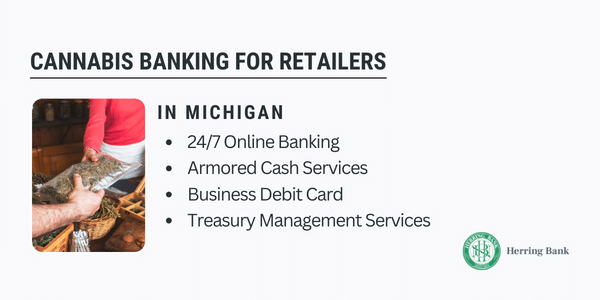
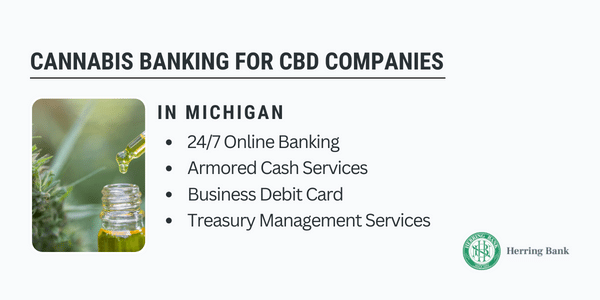
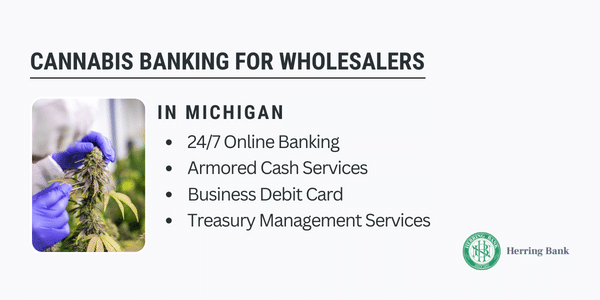
Herring Bank’s Cannabis Banking services in Michigan, designed to cater to the unique needs of the state’s legal cannabis market. This program delivers comprehensive banking solutions to help businesses flourish and simplify their operations. With 24/7 online banking, companies can manage their finances smoothly, ensuring compliance with tax regulations and facilitating digital transactions.
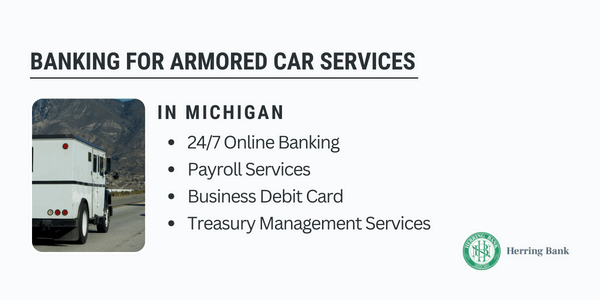
Michigan’s growing cannabis sector, including both medicinal and recreational markets, benefits from Herring Bank’s sophisticated cash management and secure transportation services, greatly reducing cash handling risks. Additionally, the bank supports business growth and stability with FDIC-insured investments.
Key features of Herring Bank’s services include online and mobile banking tailored for cannabis businesses, enhancing financial management with innovative technology. The bank also offers customized business programs and growth strategies to help entrepreneurs navigate market complexities, emphasizing safety and legal compliance. Moreover, Herring Bank streamlines payroll with various payment solutions, supporting business expansion and equipment acquisition.
Herring Bank’s dedication to the success of Michigan’s cannabis industry is demonstrated by its innovative banking solutions, making it a vital financial partner for businesses seeking dependable support in this dynamic market.
Marijuana Safe Banking in Michigan
2026 Cannabis Banking in Michigan: Laws, Licensing, Taxes and Market Status
Michigan is one of the largest legal cannabis markets in the United States, and in 2026 it is also one of the most competitive. Medical marijuana has been legal since the Michigan Medical Marihuana Act of 2008, voters approved adult-use cannabis through the Michigan Regulation and Taxation of Marihuana Act (MRTMA) in 2018, and licensed adult-use sales began December 1, 2019. Falling prices and a new wholesale tax have made Michigan cannabis banking, from cash management to tax remittance, a bigger part of running a profitable business.
Who Regulates Cannabis in Michigan
The Cannabis Regulatory Agency (CRA) licenses, inspects and disciplines every state-licensed marijuana business, from growers, processors, secure transporters and safety compliance labs to retailers, microbusinesses, designated consumption establishments and temporary marijuana events. Key rules for Michigan operators:
- Seed-to-sale tracking: all licensees record inventory, transfers and sales in Metrc, and the CRA enforces its rules through published disciplinary guidelines.
- Local control: under MRTMA Section 6 (MCL 333.27956), cities, villages and townships may opt out entirely, cap the number of marijuana establishments and set time, place and manner rules, so zoning, buffers and local licensing vary widely across the state.
- Tribal integration: in July 2025 the state signed its first cannabis compact, with the Bay Mills Indian Community, connecting tribal cannabis businesses to Metrc and the state’s licensed supply chain.
- Hemp-derived intoxicants: HB 4517 (Public Act 56 of 2021) brought intoxicating hemp-derived products such as delta-8 THC under the marijuana regulatory framework and CRA oversight.
Michigan Cannabis Taxes in 2026
Adult-use purchases carry a 10% marihuana retailers’ excise tax plus the 6% sales tax, and the Department of Treasury applies sales tax to a price that includes the excise tax. Since January 1, 2026, a new 24% wholesale marijuana tax also applies to the first sale or transfer of adult-use marijuana to a retailer, paid by the selling grower or processor, as part of the state’s road-funding plan. The industry has challenged the tax in court: the Court of Claims declined to block it in December 2025, the Michigan Supreme Court ordered the Court of Appeals to take an expedited look at the case in April 2026, and a second lawsuit was filed in March 2026 (WKAR). Until the courts rule, growers and processors must collect and remit it.
Excise revenue still flows back to communities. For fiscal year 2025, the state announced nearly $94 million in payments to 313 local governments and tribes, or $54,017.10 for each licensed retailer and microbusiness in their jurisdictions.
Michigan’s Cannabis Market in 2025 and 2026
Michigan’s licensed retailers sold about $3.17 billion of cannabis in 2025, roughly $113 million less than in 2024, even though they sold about 260,000 more pounds of product. The average price of an ounce of flower fell 16% to $58.22, and the number of licensed cannabis businesses dipped from 848 to 838 over the year, according to state data reported by Ganjapreneur. Higher volume at lower prices means more transactions, more cash and tighter margins, which is exactly where efficient banking pays off.
Federal Changes That Affect Michigan Cannabis Businesses
A Justice Department order effective April 28, 2026 moved marijuana covered by a qualifying state medical license, and FDA-approved marijuana products, to Schedule III. Michigan’s adult-use marijuana remains in Schedule I and subject to Section 280E while a broader DEA decision is pending. The SAFE Banking Act of 2026 was introduced in June 2026 and remains in committee, even after Michigan’s attorney general joined a bipartisan coalition urging passage in July 2025. Banks continue to follow FinCEN’s 2014 guidance. Michigan hemp businesses should also prepare for the federal hemp redefinition, most of which takes effect December 11, 2026.
What This Means for Banking a Cannabis Business in Michigan
Herring Bank is a compliance-first banking partner for Michigan cannabis-related businesses. We help growers, processors, retailers, microbusinesses, transporters and labs open compliant business checking and savings accounts, document CRA and municipal licensing for BSA/AML review, reconcile deposits with Metrc records, handle cash through pickup and delivery with our preferred armored courier, and run payroll, ACH, wires and electronic tax payments, including the 10% excise and 24% wholesale marijuana taxes. Ready to talk about Michigan cannabis banking? Call 877-873-0079 or request a call back.
Frequently Asked Questions (Michigan)
What taxes apply to adult-use cannabis in Michigan?
Adult-use sales are subject to aMichigan plus 6% state sales tax. Per Treasury, sales tax is calculated on the price including the 10% excise (“tax on tax”).
How are adult-use tax revenues distributed, and what did locals receive for FY2025?
For fiscal year 2025, Michigan announced nearly $94 million in adult-use marijuana excise tax payments to 313 cities, villages, townships, counties and tribes, or $54,017.10 for each licensed retailer and microbusiness located in their jurisdictions. Under MRTMA, the remaining excise revenue is shared between the School Aid Fund and the Michigan Transportation Fund. See the March 2026 announcement.
Who regulates cannabis businesses in Michigan, and what changed in 2025 and 2026?
The Cannabis Regulatory Agency (CRA) licenses and enforces statewide, while the Department of Treasury administers the 10% retail excise tax and, since January 1, 2026, the 24% wholesale marijuana tax on adult-use marijuana sold or transferred to retailers. In 2025 the CRA also updated its disciplinary guidelines, and the state signed its first tribal cannabis compact.
What inventory system is required?
Michigan uses Metrc statewide for seed-to-sale tracking. Licensees must keep inventory, transfer and sales records current in the system.
Can my city or township ban or limit cannabis businesses?
Yes. Under MRTMA Section 6 (MCL 333.27956), municipalities may completely prohibit or limit the number of marijuana establishments and set reasonable time, place and manner rules. Confirm local zoning, buffers and caps before you lease or build.
Can I host a cannabis consumption event or open a lounge?
Yes, with the correct license. Temporary marijuana events require a CRA license, and organizers must apply at least 90 days in advance; consumption venues need a designated consumption establishment license. See the CRA reminder.
Are hemp-derived intoxicants (such as delta-8) regulated by the CRA?
Yes. HB 4517 (Public Act 56 of 2021) brought intoxicating hemp-derived products under the marijuana regulatory framework and CRA oversight. Separately, the federal hemp redefinition passed in November 2025 tightens THC limits for hemp-derived products nationwide, with most provisions taking effect December 11, 2026.
Can Michigan dispensaries use banks — and what’s the federal status?
Banks serving CRBs follow FinCEN’s 2014 BSA/AML guidance. The SAFE Banking Act of 2026 (S.4942) remains pending; Michigan’s AG joined aMichigan.