

Your Ohio Cannabis Bank
Ohio Cannabis Banking
Grow your business with cannabis banking in Ohio. Herring Bank is one of the country’s leading cannabis banks, with compliant business accounts, cash management and compliance support for Ohio’s medical and adult-use licensees.
Ready to get started?

Banking Solutions for Ohio Cannabis Companies
Herring Bank’s Cannabis Banking program in Ohio is built for the state’s dual-use market, where the same dispensary may serve registered patients in the morning and adult-use customers in the afternoon. We provide business checking and savings accounts, 24/7 online banking, payment processing, electronic tax payments and payroll tools, so Ohio operators can run their finances like any other business while meeting the documentation standards regulators and bank examiners expect.
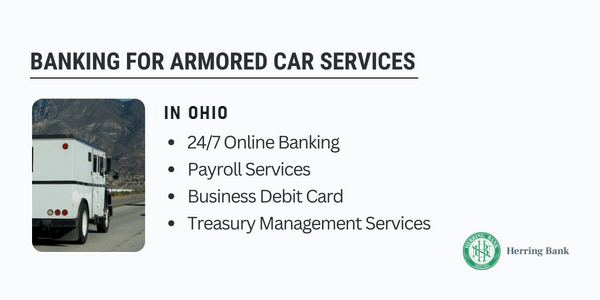
Cash is still a reality for Ohio dispensaries. We connect our clients with our preferred armored courier for pickup and delivery, so sales from Cincinnati, Columbus, Cleveland, Dayton, Toledo and Akron reach the bank without staff driving deposits across town. Deposits are reconciled against Metrc records and Division of Cannabis Control licensing as part of our ongoing monitoring.
Herring Bank also serves the people behind the licenses. Owners and employees of licensed Ohio cannabis businesses can qualify for cannabis home loans through our mortgage team, and our Cannabis Business Advisory service helps new licensees set up accounts, controls and reporting from day one.
Financial Services for Ohio Cannabis Businesses
Ohio’s cannabis businesses, from Level I cultivators and processors to testing labs and dual-use dispensaries, have financial needs that most banks will not touch. Herring Bank meets those needs with accounts designed for licensed cannabis operations, so cash flow, vendor payments and tax remittance run on schedule.
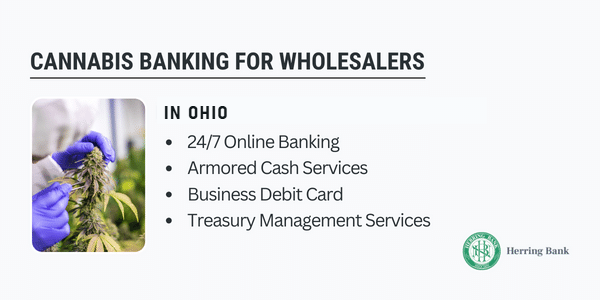
Our digital tools matter as much as our accounts. Online and mobile banking give Ohio operators round-the-clock visibility into every location, while debit cards, check services and wire access put the full range of business banking within reach. Our services for Ohio cannabis businesses are listed below.
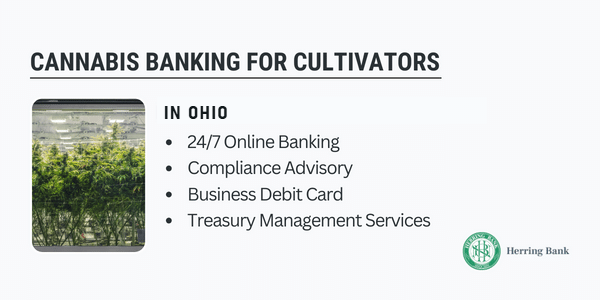
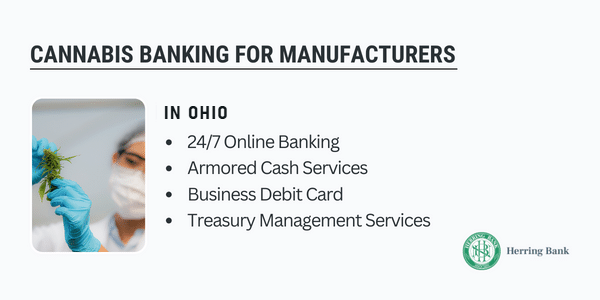
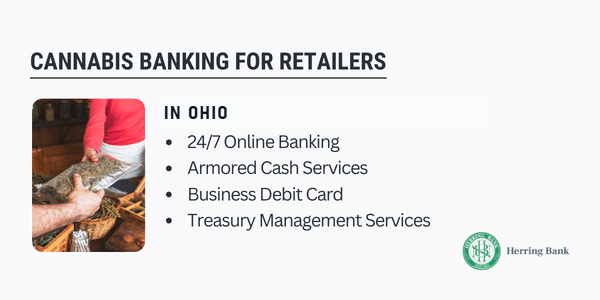
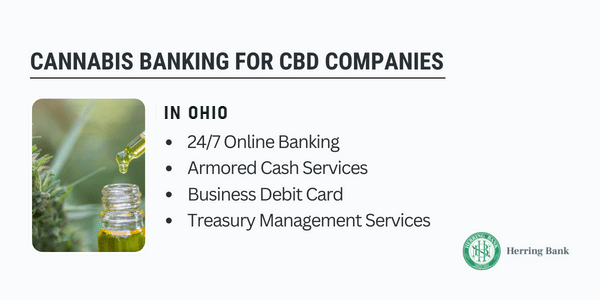
Marijuana Banking in Ohio
Herring Bank’s Cannabis Banking Program for Ohio is a purpose-built platform for a market that grew from medical-only to more than a billion dollars in combined annual sales in a little over a year. Ohio’s adult-use sales passed $836 million in 2025 on top of a mature medical program, and the Division of Cannabis Control continues to license new dispensaries under the 400-store cap set by Senate Bill 56. That growth creates demand for banking that is both sophisticated and compliant.
Our program gives Ohio cannabis enterprises specialized checking and savings accounts, 24/7 online banking for multi-location oversight, payment processing for customer transactions and electronic tax payments for Ohio’s 10% adult-use excise tax and state and local sales taxes. Recognizing how much cash still moves through dispensaries, we pair cash management accounts with secure pickup and delivery through our preferred armored courier.
To support your workforce, Herring Bank provides employee accounts, direct deposit payroll, ACH payments and wire transfers, so paying budtenders, growers, vendors and the state is routine. Every relationship is guided by FinCEN’s BSA/AML expectations for marijuana-related businesses, giving Ohio operators a durable financial foundation in a market that is still writing its rules.
2026 Cannabis Banking in Ohio: Laws, Licensing, Taxes and Market Status
Ohio is the newest large adult-use market in the Midwest, and 2026 has been its busiest regulatory year yet. Medical marijuana has been legal since House Bill 523 in 2016, with dispensary sales starting in January 2019. Voters approved Issue 2 in November 2023, adult-use possession became legal that December, and licensed adult-use sales began on August 6, 2024 at dispensaries holding dual-use certificates. For the cultivators, processors, labs and dispensaries now serving both programs, Ohio cannabis banking means compliant accounts, secure cash logistics and a bank that can document state licensing for federal compliance.
Who Regulates Cannabis in Ohio
The Division of Cannabis Control (DCC), part of the Ohio Department of Commerce, licenses and inspects every medical and adult-use operator in the state. Key rules for Ohio operators in 2026:
- Senate Bill 56: effective March 20, 2026, the bill moved the adult-use program into Ohio Revised Code Chapter 3796 alongside the medical program, capped THC at 70% for extracts and 35% for flower, limited the state to 400 dispensaries, kept home grow at six plants per adult and twelve per residence, and recriminalized cannabis obtained from anywhere other than an Ohio licensee or a legal home grow.
- Purchase limits by rule: on October 6, 2026 the DCC added per-transaction package limits, including one ounce of flower, three vape devices, 10 mg portions for edibles and infused beverages, and six clones, plants or seeds.
- Seed-to-sale tracking: all licensees record inventory, transfers and sales in Metrc.
- Local control: cities, villages and townships may prohibit or limit adult-use operators, and state law keeps dispensaries at least 500 feet from schools, churches, libraries, playgrounds and parks. More than a hundred local moratoriums were in place in 2026, so zoning varies widely from one community to the next.
- Hemp-derived intoxicants: SB 56 restricted intoxicating hemp products to the licensed system, with a temporary pathway for qualifying drinkable cannabinoid products that is scheduled to end December 31, 2026 unless lawmakers act.
Ohio Cannabis Taxes in 2026
Adult-use purchases carry a 10% excise tax in addition to the 5.75% state sales tax and any county or transit sales tax. Medical purchases by registered patients are exempt from the excise tax. Licensees file and pay through the Ohio Department of Taxation, which makes a bank that can handle electronic tax payments and clean, auditable deposits a practical necessity rather than a convenience.
Ohio’s Cannabis Market in 2025 and 2026
Ohio’s first full year of adult-use sales produced more than $836 million in recreational sales in 2025, with medical sales adding more than $233 million. By July 2026 the DCC reported cumulative sales of about $4.07 billion since the medical program began, including roughly $1.68 billion in adult-use sales. Around 200 dual-use dispensaries were operating in early 2026, with dozens more licensed but not yet open under the 400-store cap. That growth means more transactions, more cash and more payroll, exactly where efficient banking pays off.
Federal Changes That Affect Ohio Cannabis Businesses
A Justice Department order effective April 28, 2026 moved marijuana covered by a qualifying state medical license, and FDA-approved marijuana products, to Schedule III. Adult-use marijuana remains in Schedule I and subject to Section 280E while broader federal decisions are pending. The SAFE Banking Act of 2026 was introduced in June 2026 and remains in committee, so banks continue to follow FinCEN’s 2014 guidance for marijuana-related businesses. Ohio hemp businesses should also prepare for the federal hemp redefinition, most of which takes effect December 11, 2026.
What This Means for Banking a Cannabis Business in Ohio
Herring Bank is a compliance-first banking partner for Ohio cannabis-related businesses. We help cultivators, processors, testing labs and dual-use dispensaries, from Cincinnati to Cleveland and Columbus, open compliant business checking and savings accounts, document DCC and local licensing for BSA/AML review, reconcile deposits with Metrc records, handle cash through pickup and delivery with our preferred armored courier, and run payroll, ACH, wires and electronic tax payments, including Ohio’s 10% excise tax. Ready to talk about Ohio cannabis banking? Call 877-873-0079 or request a call back.
Frequently Asked Questions (Ohio)
What taxes apply to cannabis in Ohio?
Adult-use purchases carry a 10% state excise tax on top of the 5.75% state sales tax and any local sales tax. Medical marijuana purchases by registered patients are not subject to the 10% excise tax. Licensees remit through the Ohio Department of Taxation.
Who regulates cannabis businesses in Ohio, and what changed in 2026?
The Division of Cannabis Control (DCC) in the Ohio Department of Commerce licenses and inspects cultivators, processors, testing labs and dispensaries for both the medical and adult-use programs. Senate Bill 56, effective March 20, 2026, rewrote the adult-use statute, capped THC at 70% for extracts and 35% for flower, limited dispensaries to 400 statewide and tightened rules on hemp-derived intoxicants. In October 2026 the DCC added per-transaction package limits by rule.
What inventory system is required?
Ohio licensees track inventory, transfers and sales in Metrc, the state’s seed-to-sale system. Banks like Herring Bank reconcile deposits against those records as part of ongoing monitoring.
Can my city or township ban cannabis businesses?
Yes. Ohio law lets municipalities and townships prohibit or limit adult-use operators within their borders, and more than a hundred local moratoriums were in place in 2026. Confirm local zoning and the 500-foot buffers from schools, churches, libraries, playgrounds and parks before you lease or build.
How large is Ohio’s cannabis market?
Adult-use sales passed $836 million in 2025, the first full year of recreational sales, with medical sales of more than $233 million on top. By July 2026 cumulative sales since the programs began had topped $4 billion, including about $1.68 billion in adult-use sales, according to DCC data.
Can Ohio dispensaries use banks, and what is the federal status?
Yes. Herring Bank serves Ohio cannabis-related businesses under FinCEN’s 2014 guidance, with enhanced due diligence and ongoing monitoring. Since April 28, 2026, marijuana covered by a qualifying state medical license has been in Schedule III, while adult-use marijuana remains in Schedule I. The SAFE Banking Act of 2026 (S. 4942) is still in committee.


