Your Local Albany Cannabis Bank
Albany Cannabis Banking
Discover the best cannabis and CBD banking in Albany with Herring Bank. We’re one of America’s fastest-growing cannabis banks.
Ready to get started?

Comprehensive Cannabis Banking
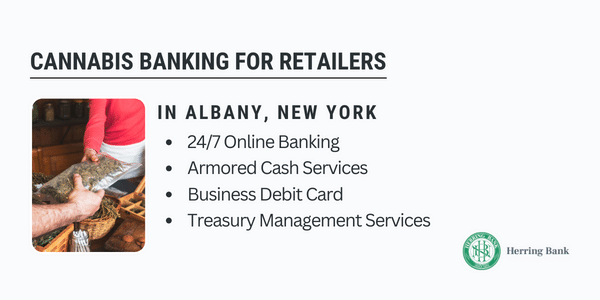
Herring Bank’s Cannabis Banking initiative is specifically designed to address the nuanced needs of the burgeoning cannabis sector in Albany, NY. This program offers a comprehensive array of financial services tailored for businesses within the legal cannabis, CBD, and marijuana banking landscape. Ensuring 24/7 access to online banking, the initiative allows cannabis businesses to efficiently manage their financial operations and adhere to New York‘s regulatory frameworks, including assistance with electronic tax remittances, crucial for compliance and smooth operation in the state’s legal cannabis market.
Recognizing the significant cash handling challenges faced by dispensaries in both the medical and recreational marijuana sectors, Herring Bank provides specialized cash management solutions, inclusive of secure transport services, to safely navigate the high-volume cash flows typical in the industry. The bank also offers investment opportunities aimed at bolstering the financial base of cannabis-related businesses, critical for sustaining growth and innovation in this rapidly evolving sector.
Herring Bank’s suite of services extends to employee-centric solutions, featuring streamlined payroll systems and various payment options like ACH and wire transfers, to ensure efficient salary distribution and fund transfers. Tailored account structures are also available to support business expansion and other growth plans within the cannabis industry, demonstrating Herring Bank’s commitment to enhancing the operational efficiency and financial health of cannabis businesses in Albany. This holistic banking solution underscores Herring Bank’s dedication to supporting the legalization movement and the growing medical cannabis community, ensuring they thrive in New York’s dynamic economic and regulatory environment.
Albany, NY Cannabis Bank
In the dynamic landscape of Albany, NY’s legal cannabis industry, Herring Bank stands out for its specialized cannabis banking and financial services. The bank has tailored its offerings to meet the unique needs of cannabis businesses, facilitating their growth with comprehensive business and banking solutions, including a meticulous application process for newcomers.
With a deep understanding of New York’s complex cannabis regulations, Herring Bank is well-equipped to provide vital support and guidance to businesses navigating the state’s burgeoning cannabis market. As a dependable financial ally, Herring Bank plays a crucial role in assisting cannabis enterprises to prosper within New York’s ever-evolving regulatory framework.
Herring Bank enriches its service portfolio with educational and advisory services aimed at ensuring cannabis businesses remain compliant with New York state regulations. This proactive approach not only helps CRB’s maintain legal compliance but also gears them up for sustained growth and success in the competitive cannabis industry. Herring Bank’s commitment to banking excellence and innovation marks it as an indispensable partner for cannabis enterprises aspiring to flourish in Albany’s vibrant economy.
Albany Cannabis Banking


2026 Cannabis Banking in Albany, New York: Laws, Licensing and Market Status
Albany is where New York’s cannabis rules are written and where many of them are argued over. The Cannabis Control Board meets in the capital regularly (its March 5, 2026 meeting was in Albany), and the Capital Region has developed a solid licensed market of its own. In mid-October 2026, the Office of Cannabis Management’s dispensary verification list showed 18 licensed dispensaries with an Albany mailing address, plus 10 in Schenectady, 7 in Troy and 3 in Latham. For dispensary owners, cultivators and processors in and around the city, 2026 brings more competition, tighter tracking rules and a federal change that matters mainly to medical operators.
Local Rules for Albany Cannabis Businesses
Under the Marihuana Regulation and Taxation Act (MRTA), cities, towns and villages could opt out of hosting adult-use dispensaries and on-site consumption lounges. Albany did not, which is why the city has one of the densest clusters of storefronts outside New York City and Buffalo. The city does not issue its own cannabis licenses. Instead, local rules work through zoning, municipal notice of new applications and the 4% local share of the retail excise tax, which goes to counties and municipalities. State law requires applicants to notify the municipality before applying and sets school and house-of-worship proximity limits that the Cannabis Control Board weighs when it approves new storefronts.
New York’s Statewide Framework in Brief
- Regulators: the Office of Cannabis Management (OCM) and the five-member Cannabis Control Board license and regulate medical, adult-use and cannabinoid hemp businesses statewide.
- Licenses: 2,322 adult-use licenses had been issued by August 2026, including 537 retail dispensaries, 360 CAURD licenses, 574 processors, 328 microbusinesses, 275 cultivators and 248 distributors. 56% went to Social and Economic Equity applicants.
- Taxes: a 13% retail excise tax (9% state, 4% local) at the register, plus a 9% tax on adult-use product sales at the distributor level, which replaced the per-milligram potency tax on June 1, 2024.
- Enforcement: legislation Governor Hochul signed with the FY2024 budget gave OCM and the Department of Taxation and Finance civil penalties and other tools against unlicensed sellers, and made selling cannabis without a license a crime.
- Renewals: adult-use licenses renew every two years, and OCM asks licensees to file at least 60 days before expiration.
The 2026 Market Picture
Statewide adult-use sales reached $1.69 billion in 2025, and open dispensaries grew from 582 in February 2026 to 705 in August. At its September 2026 meeting, OCM lowered its 2026 sales forecast to $2 billion, citing more accurate Metrc data and retail price declines of 10% to 15%. OCM is also phasing in Metrc seed-to-sale tracking statewide, and the state began paying Metrc tag costs for licensees on September 1, 2026. For a Capital Region dispensary, more competition and lower prices make accurate cash reconciliation and predictable banking costs more important.
Federal Changes for Capital Region Operators
Effective April 28, 2026, the U.S. Department of Justice and DEA moved FDA-approved marijuana products and marijuana subject to a qualifying state medical license from Schedule I to Schedule III. In New York, that applies to the medical program’s registered organizations, which gain a DEA registration pathway and are expected to be free of Section 280E going forward. Albany’s adult-use dispensaries are not covered. Adult-use marijuana remains in Schedule I while the DEA’s broader rescheduling proceeding continues.
Federal banking law has not changed. The SAFE Banking Act of 2026 (S. 4942), with a House companion, H.R. 9471, was introduced in June 2026 and remains in committee. Until Congress acts, cannabis businesses need a bank that follows FinCEN guidance for marijuana-related businesses, including enhanced due diligence, ongoing monitoring and Suspicious Activity Report (SAR) filing.
What This Means for Banking a Cannabis Business in Albany
Herring Bank works with Albany-area dispensaries, CAURD operators, microbusinesses, cultivators, processors and distributors to open compliant operating accounts, document OCM licensing and Metrc activity for BSA/AML review, and manage cash with pickup and delivery through our preferred armored courier. We also run payroll, ACH, wires and electronic payment of New York’s adult-use cannabis taxes. Ready to talk about Albany cannabis banking? Call 877-873-0079 or request a call back.