

What Is a Smart Safe? How It Works for Cash Businesses
Talk to our business banking team Herring Bank · NMLS #415783 · No obligation
A smart safe is a locked cash safe with a built-in bill validator that checks, counts and records every note as it is deposited, then reports the total electronically. Because the safe knows exactly what it holds, a bank can credit the deposit to your account from that data instead of waiting for the cash to be picked up and counted again. Businesses use smart safes to stop counting cash by hand, keep less currency in drawers and get a clean deposit record.
The term also covers home safes with Wi-Fi locks and fingerprint readers, which are a different product. This guide is about business smart safes, the kind check cashers, retailers, restaurants and other cash businesses use to manage the currency they take in every day.
Key Takeaways
- A smart safe validates, counts and records each bill as it is deposited, so the safe always knows what it holds.
- It reports deposit totals electronically, which lets a bank credit the cash before an armored courier collects it.
- Cashiers can deposit but not open the safe, and each drop is logged to a user ID and time.
- A bank smart safe service bundles the safe, deposit credit and armored pickup, usually for a monthly fee.
- Smart safes suit any business with steady cash volume: check cashers, convenience stores, restaurants, grocery and more.
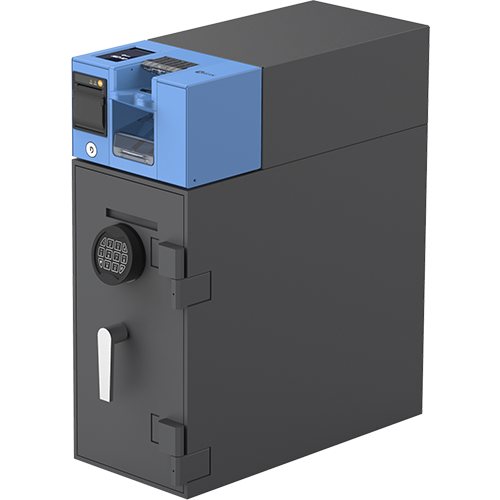
How Does a Smart Safe Work?
A smart safe replaces the envelope-and-drop-slot routine with a machine that counts as it stores. The process is the same on most models:
- The cashier signs in with a user ID.
- Bills go into the validator. It authenticates each note, rejects suspect or damaged bills to a separate tray and counts the rest.
- Cash drops into sealed storage, a cassette or bag that store staff can’t open.
- The safe prints a receipt and adds the drop to the shift and daily totals.
- At the daily cutoff, the safe reports the day’s verified deposits to the bank or cash-in-transit provider.
- An armored courier collects the sealed cassette or bag on a set schedule.
The Kisan KD10 is a typical example: it validates up to 300 notes a minute, stores 2,000 notes in a cassette or 4,500 in a bag, and separates cashier and manager access.
Smart Safe vs. Drop Safe
| Drop safe | Smart safe | |
|---|---|---|
| What goes in | Envelopes or loose bills | Individual bills through a validator |
| Counting | By hand, later | Automatic, at deposit |
| Counterfeit check | None | Every note |
| Deposit record | Paper log, if any | Electronic, by user and time |
| Bank credit | After the cash reaches the bank and is counted | From the safe’s reported totals, with a bank deposit-credit service |
Cash recyclers go one step further and dispense counted cash back to the drawer. Our comparison of smart safes, drop safes and cash recyclers covers when each one makes sense.
What a Smart Safe Does for a Cash Business
Less time counting
Managers stop counting and recounting drawers at the end of each shift. The safe’s end-of-shift and end-of-day reports give the totals, so closing takes minutes instead of an hour.
Less cash at risk
When excess cash goes into a safe cashiers can’t open, less of it sits in drawers or a back-room safe. That lowers the cash exposed in a robbery and removes the opportunity for internal theft.
Faster access to the day’s cash
With a bank deposit-credit service, the day’s verified deposits can be credited to your account without waiting for the courier. Herring Bank calls this Daily Deposit Credit, available to qualifying customers. Because access no longer depends on the pickup, many businesses can schedule fewer pickups.
A clean record
Every deposit is time-stamped and tied to a user. That supports cash reconciliation, investigations into shortages and the recordkeeping a cash-heavy business needs. For money service businesses, which must file Currency Transaction Reports on currency transactions over $10,000 in a day, a clear record of cash activity helps the compliance program; see MSB AML program requirements.
Who Uses Smart Safes?
- Check cashers and money service businesses, whose teller lines handle currency all day. See smart safes for check cashers and MSBs.
- Convenience stores and gas stations, with register drops through every shift.
- Restaurants and quick-service chains, with high cash volume and frequent shift changes.
- Grocery stores, including check-cashing and bill-payment counters.
- Laundromats, car washes and vending operators, with currency from unattended machines.
- Licensed cannabis businesses, which still handle large amounts of cash; Herring Bank serves them through a separate cannabis banking program.
How Smart Safe Services Are Priced
Most businesses don’t buy a smart safe outright. They pay a monthly service fee that covers the equipment, monitoring, maintenance, deposit credit and armored pickups. The fee depends mostly on your cash volume, the number of locations and how often the courier comes. Our guide to smart safe costs explains what drives the price and how to compare quotes.
Frequently Asked Questions
Ready to take the next step?
This article is for educational purposes only and does not constitute financial, legal, or tax advice. It is not a commitment to lend. Loan programs, rates, and eligibility requirements are subject to change without notice. Consult a qualified professional before making financial decisions.


