

Maryland Cannabis Banking
Empower Your Business with Herring Bank’s Premier Banking Solutions for Cannabis and CBD Enterprises in The Free State
Ready to get started?

Discover Maryland Cannabis Banking Solutions
Tailored Cannabis Banking Services for Maryland
2026 Cannabis Banking in Maryland: Laws, Licensing and Market Status
Maryland runs a combined medical and adult-use cannabis market of more than 100 dispensaries. Its tax rate rose in 2025, and a first round of social equity licensees is moving from conditional to full licenses. For dispensaries, growers and processors, the result is higher tax remittances, more competitors coming online and steady compliance oversight, all of which run through the business’s bank account.
Maryland’s Cannabis Law and the Maryland Cannabis Administration
Maryland legalized medical cannabis in 2014, and voters approved adult-use legalization in 2022. The Cannabis Reform Act of 2023 created the adult-use market and the Maryland Cannabis Administration (MCA), which licenses and regulates growers, processors, dispensaries, testing labs and related businesses. The MCA is led by Director Tabatha Robinson. Its Office of Compliance and Regulation completed 665 inspections in 2025, 529 of them at dispensaries, according to the MCA’s fiscal 2027 budget testimony.
Licensing: The Social Equity Round and What Comes Next
Maryland’s first adult-use licensing round was reserved for social equity applicants, with lotteries held March 14 and June 28, 2024. Of 205 applicants selected, 192 moved forward to conditional licensure, and 13 had reached full licensure at the time of the MCA’s budget testimony. Any second round depends on a state disparity study, which the Maryland Department of Transportation published October 1, 2025; the MCA is reviewing it with counsel. The MCA has installed “Trusted Source” signs with a QR code verification link at all 109 licensed dispensaries.
Maryland Cannabis Taxes and Where the Money Goes
Maryland’s sales and use tax on adult-use cannabis rose from 9% to 12% on July 1, 2025, under the Budget Reconciliation and Financing Act of 2025. The Comptroller collected $28.7 million in cannabis sales tax from April through June 2026. By statute, 35% of quarterly revenue goes to the Community Reinvestment and Repair Fund, 5% to counties (half of which passes to municipalities with dispensaries) and 5% to the Cannabis Public Health Fund.
Enforcement, Hemp-Derived THC and Equity Measures
- Unlawful THC sales: in December 2025 the MCA and the Alcohol, Tobacco, and Cannabis Commission launched a dedicated tip line, THCtips.maryland.gov, for reporting unlawful THC product sales outside licensed dispensaries.
- Pardons: in June 2024 Governor Wes Moore pardoned more than 175,000 prior cannabis convictions.
- Federal hemp change: the federal hemp redefinition takes full effect December 11, 2026, with the synthetic-cannabinoid exclusion starting November 12, 2026.
Federal Changes That Affect Maryland Cannabis Businesses
Effective April 28, 2026, the U.S. Department of Justice and DEA moved FDA-approved marijuana products and marijuana subject to a qualifying state medical license from Schedule I to Schedule III. Maryland’s licensees serve both medical patients and adult consumers, so the April 2026 rescheduling covers the medical side of their business, which gains a DEA registration pathway and is expected to be free of Section 280E going forward. Adult-use sales remain in Schedule I and subject to 280E while the DEA’s broader rescheduling proceeding continues, so separate tracking of medical and adult-use revenue matters.
Federal banking law has not changed. The SAFE Banking Act of 2026 (S. 4942), with a House companion, H.R. 9471, was introduced in June 2026 and remains in committee. Until Congress acts, cannabis businesses need a bank that follows FinCEN guidance for marijuana-related businesses, including enhanced due diligence, ongoing monitoring and Suspicious Activity Report (SAR) filing.
What This Means for Banking a Cannabis Business in Maryland
Herring Bank opens compliant operating accounts for Maryland dispensaries, growers, processors, social equity licensees moving to full licensure, and ancillary businesses. We document MCA licensing for BSA/AML review, keep separate account structures for medical and adult-use revenue, provide cash pickup and delivery through our preferred armored courier, and run payroll, ACH, wires and electronic payment of the 12% cannabis sales and use tax. Ready to talk about Maryland cannabis banking? Call 877-873-0079 or request a call back.
Herring Bank’s Dedicated Banking Solutions for Maryland’s Cannabis Industry
Herring Bank offers specialized banking solutions tailored to the unique needs of cannabis-related businesses (CRBs) in Maryland. By leveraging successful strategies from other markets, Herring Bank navigates the challenges of the cannabis banking environment, providing a range of services designed to support the growth and compliance of CRBs.
- Checking and Savings Accounts: Specifically designed for cannabis businesses, ensuring secure and efficient fund management.
- Online Banking Capabilities: With 24/7 online banking access, CRBs can manage their finances remotely, facilitating seamless operations and real-time financial oversight.
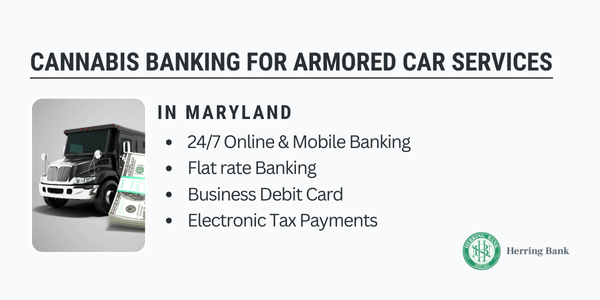
- Cash Management Systems: Recognizing the importance of secure cash handling, Herring Bank supports secure cash transport services to minimize risks associated with cash transactions.
- Advisory Programs: Helping cannabis businesses navigate the regulatory landscape, ensuring compliance with state laws and optimizing business operations.
These services are pivotal in fostering a structured and regulated cannabis industry in Maryland, focusing on safety, compliance, and accessibility for both medical and recreational companies. Herring Bank remains committed to providing comprehensive and tailored financial solutions to support the growth of Maryland’s cannabis businesses.
What Cities in Maryland Does Herring Bank Provide Cannabis Banking?
Herring Bank provides Cannabis Banking services to Cannabis-Related Businesses (CRBs) in cities including, but not limited to, Baltimore, Columbia, Germantown, Silver Spring, Waldorf, Glen Burnie, Ellicott City, Frederick, Dundalk, Rockville, Bethesda, Gaithersburg, Bowie, Towson, Aspen Hill, Wheaton, Bel Air South, Potomac, Severn, and North Bethesda.


